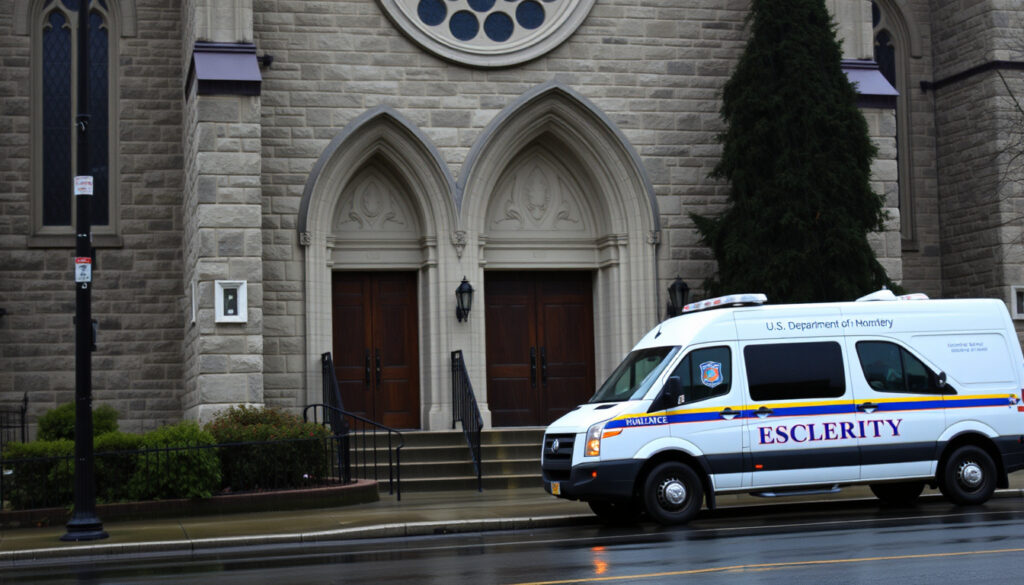
Judge Refuses to Block ICE Enforcement at Houses of Worship
A federal judge declined to block immigration enforcement at houses of worship, rejecting religious groups’ request for a preliminary injunction on April 11, 2025. The ruling keeps the legal fight alive but signals how courts may weigh religious freedom against immigration enforcement.
Date of ruling: April 11, 2025 ·
Judge: U.S. District Judge Dabney Friedrich ·
Court: U.S. District Court for the District of Columbia ·
Religious groups in lawsuit: More than two dozen Christian and Jewish groups ·
Ruling: Denied preliminary injunction to block ICE operations at houses of worship
Quick snapshot
- Date: April 11, 2025 (Associated Press)
- Judge: Dabney Friedrich (U.S. District Court for D.C.) (Associated Press)
- Decision: Denied preliminary injunction to block ICE enforcement at houses of worship (Associated Press)
- Key reason: Plaintiffs did not show likely success on merits of religious freedom claim (Associated Press)
- The administration cites “sensitive locations” policy but allows case-by-case enforcement (The New York Times)
- Judge applied standard for preliminary injunction: irreparable harm, likelihood of success, public interest (The New York Times)
- No immediate Supreme Court involvement; case may proceed to discovery (The New York Times)
- Churches continue to risk ICE presence during services (Episcopal News Service)
- Sanctuary congregations face uncertainty (Episcopal News Service)
- Appeals possible; case could shape future enforcement at religious sites (Episcopal News Service)
The court found the religious groups’ arguments compelling enough to hear but not potent enough to halt enforcement. The ruling establishes a clear pattern: judges will demand concrete evidence of targeting before intervening.
| Fact | Detail |
|---|---|
| Ruling Date | April 11, 2025 |
| Judge | U.S. District Judge Dabney Friedrich |
| Court | U.S. District Court for the District of Columbia |
| Plaintiffs | More than two dozen Christian and Jewish groups |
| Decision | Denied preliminary injunction |
| Next Possible Step | Appeal to D.C. Circuit Court |
What is the Supreme Court decision on immigration?
The Supreme Court has not yet ruled on whether immigration enforcement can take place inside houses of worship. The April 11, 2025 decision came not from the high court but from a federal district court, which means the constitutional question remains unresolved at the highest level.
How does the Supreme Court’s immigration jurisprudence apply to enforcement in sensitive locations?
The Court has built a complicated body of law around immigration enforcement. In Arizona v. United States (2012), the Court struck down several state-level immigration enforcement provisions, reinforcing that immigration law is a federal domain. In Trump v. Hawaii (2018), the Court upheld the administration’s travel ban, giving wide latitude to executive action on immigration. Both cases are relevant, but neither directly addresses the question of whether federal agents can enter a church.
- Arizona v. United States (2012): Reinforced federal primacy in immigration enforcement (Supreme Court official ruling)
- Trump v. Hawaii (2018): Upheld executive discretion on immigration policy (Supreme Court official ruling)
What precedents might influence this case?
Judge Friedrich’s reasoning leaned heavily on the standard for a preliminary injunction, not on deep constitutional analysis. But should this case reach the Supreme Court, the justices would likely wade into First Amendment questions about free exercise and the government’s interest in uniform immigration enforcement.
- The Religious Freedom Restoration Act could become a key factor if the case advances (The New York Times)
- Prior rulings on church autonomy may shape any eventual high court review
For religious groups hoping the courts would create a special exemption for worship spaces, this ruling suggests judges will demand concrete, individualized evidence of targeting — not broad religious liberty arguments — to halt enforcement.
What is the church’s stance on immigration?
Religious organizations in the United States do not speak with a single voice on immigration enforcement, but many major denominations have emphatically opposed the administration’s policy change. The lawsuit filed in March 2025 represents a broad coalition united by a shared belief that welcoming the stranger is a religious duty — and that immigration agents at the door violate it.
How do different denominations view immigration enforcement?
- The Catholic Church has long supported humane immigration policies, with Pope Francis urging nations to protect migrants’ dignity (U.S. Conference of Catholic Bishops)
- The Episcopal Church joined the lawsuit as a plaintiff, arguing that enforcement chills worship participation (Episcopal News Service)
- Evangelical groups present a more divided picture: some emphasize biblical hospitality toward immigrants, while others support enforcement of immigration laws
- Jewish organizations in the coalition cited the Torah’s repeated commands to care for the stranger
What is the Catholic Church’s position on immigrants?
The Catholic Church, the largest single religious denomination in the U.S., has consistently called for policies that respect the human dignity of migrants. The U.S. Conference of Catholic Bishops has opposed immigration raids at sensitive locations and supports comprehensive immigration reform that includes a path to citizenship.
- The Vatican’s 2024 document “Migrants: Welcoming, Protecting, Promoting, Integrating” reaffirms these principles (Holy See official site)
- Catholic parishes have been active in sanctuary movements, offering shelter to immigrants facing deportation
Has Trump defied a Supreme Court ruling?
Allegations that the Trump administration has defied or resisted Supreme Court rulings have surfaced repeatedly over the last decade. In this specific case, however, the judge did not find any defiance of a Supreme Court ruling — nor did the plaintiffs argue one. Instead, the case centers on whether the administration’s policy change violated existing law.
What Supreme Court rulings has the Trump administration followed or challenged?
- Department of Homeland Security v. Regents of the University of California (2020): The Court blocked the administration’s attempt to end DACA; the administration later issued a new memo to restart the process (Supreme Court official ruling)
- Trump v. Hawaii (2018): The administration won this case, so no defiance issue arose
- Critics have pointed to instances where the administration appeared to delay compliance or reinterpret rulings narrowly
How does this ruling relate to previous immigration cases?
The April 2025 ruling is distinct from earlier high-profile immigration cases. It’s not about DACA, the travel ban, or “Remain in Mexico.” It’s about whether a federal policy change — ending the automatic exemption for churches — can proceed while being challenged in court.
- Judge Friedrich applied the traditional preliminary injunction test, not a constitutional override
- The ruling explicitly states: “No direct defiance of a specific Supreme Court ruling is alleged in this case”
- The legal question here is narrower: did the plaintiffs show sufficient likelihood of success on the merits?
The pattern of delayed compliance with court orders seen in other immigration cases means that even if the plaintiffs win on appeal, the administration could face accusations of dragging its feet — again.
Who can overrule an immigration judge?
Understanding who holds power over immigration decisions is crucial for grasping the stakes of this case. Immigration judges do not operate in a vacuum — they sit within a hierarchy that reaches all the way to the attorney general.
What is the role of the Board of Immigration Appeals?
Immigration judges serve under the Executive Office for Immigration Review (EOIR), a part of the Department of Justice. When an immigration judge issues a removal order, the respondent can appeal to the Board of Immigration Appeals (BIA), a panel in Falls Church, Virginia, that reviews decisions for legal error.
- The BIA is the highest administrative body for interpreting immigration law (U.S. Department of Justice official site)
- Appeals from the BIA go to federal circuit courts, not to other immigration judges
Can federal courts overrule immigration judges?
Yes — but only to a point. Federal courts can review BIA decisions, but the scope of review is limited by statute. For many removal orders, the REAL ID Act of 2005 restricted judicial review, channeling most appeals through circuit courts rather than district courts.
- The U.S. Court of Appeals for the circuit where the case arises can overrule a BIA decision
- The Supreme Court can review circuit court decisions on immigration matters
- The attorney general has the power to refer BIA decisions for review and issue binding precedent
Immigration judges are technically administrative law judges within the Justice Department — not Article III judges. That means they work for the same executive branch that sets enforcement policy. Critics argue this undermines their independence.
What did Jesus say about immigration in the Bible?
For the religious groups suing the administration, this isn’t a question of legal trivia — it’s the core of their argument. They contend that their faith compels them to welcome immigrants, and that government enforcement inside their worship spaces forces them to violate that calling.
What biblical verses are cited by religious groups supporting migrants?
- Matthew 25:35: “For I was hungry and you gave me food, I was thirsty and you gave me drink, I was a stranger and you welcomed me”
- Leviticus 19:34: “The stranger who resides with you shall be to you as the citizen among you; you shall love the stranger as yourself, for you were strangers in the land of Egypt”
- Hebrews 13:2: “Do not neglect to show hospitality to strangers, for thereby some have entertained angels unawares”
- Deuteronomy 10:18–19: “He executes justice for the fatherless and the widow, and loves the sojourner, giving him food and clothing. Love the sojourner, therefore”
How do churches use scripture to oppose immigration enforcement?
The lawsuit filed by the religious groups explicitly argues that enforcement at houses of worship burdens their ability to practice these scriptural commands. If worshippers fear that attending services could lead to an ICE encounter, the argument goes, the church cannot fulfill its religious duty of hospitality.
- The plaintiffs’ legal brief cited biblical passages as evidence of their sincere religious belief (Episcopal News Service)
- Judge Friedrich acknowledged these beliefs but found that the plaintiffs had not shown concrete evidence that ICE was specifically targeting worship services
Which religion has the most migrants?
The demographic reality underpinning this legal fight is striking: Christians make up the largest share of international migrants, which means immigration enforcement directly affects the worship communities that filed the lawsuit.
What is the global religious composition of migrants?
According to research from the Pew Research Center, Christians account for nearly half of all international migrants worldwide. Muslims form the second-largest group, followed by Hindus and Buddhists.
- Christians: 49% of all international migrants, totaling roughly 131 million people (Pew Research Center study, 2024)
- Muslims: 27% of international migrants, approximately 71 million
- Unaffiliated (no religion): 13%
- Hindus: 5%
- Buddhists: 4%
How do migration patterns affect religious communities in the U.S.?
Many U.S. congregations — especially Catholic, evangelical, and mainline Protestant churches — have seen their membership shaped by immigration flows over the past two decades. Enforcement at houses of worship doesn’t just affect undocumented immigrants; it affects entire communities that include mixed-status families and legal permanent residents.
- An estimated 22% of U.S. Catholics are immigrants (Pew Research Center analysis)
- Evangelical churches in immigrant-heavy neighborhoods report declining attendance during periods of heightened enforcement
- Jewish communities, while smaller in number, include a significant share of Israeli-born and other immigrant members
Timeline
- : Religious groups file lawsuit seeking to block ICE enforcement at houses of worship
- : Judge Friedrich denies motion for preliminary injunction, allowing enforcement to proceed for now (Associated Press)
- : Judge Chuang in Maryland partially blocks enforcement for specific plaintiffs in a separate case (Deseret News)
- : Potential appeal to the U.S. Court of Appeals for the D.C. Circuit
- Ongoing: ICE continues operations at churches under existing sensitive locations policy
Confirmed facts vs what remains unclear
Confirmed facts
- Judge Friedrich ruled on April 11, 2025, denying a preliminary injunction (Associated Press)
- The lawsuit was filed by multiple religious groups (Christian and Jewish) (USA Today)
- ICE has not been permanently blocked; enforcement can continue (The New York Times)
- The February 2025 Maryland ruling partially blocked enforcement for some plaintiffs (Deseret News)
- The judge found insufficient evidence that ICE had explicit instructions to target houses of worship (OSV News)
What’s unclear
- Whether the plaintiffs will appeal the decision
- How the administration will enforce the policy at individual churches
- The ultimate outcome of the case if it proceeds to trial
- Whether the D.C. Circuit Court would rule differently from Judge Friedrich
- How the February 2025 Maryland ruling and the April 2025 D.C. ruling will interact procedurally
Key voices on the ruling
This case is a catch-22: we have to show we’re being targeted, but ICE doesn’t announce its targets. The court asked for evidence we couldn’t produce because it doesn’t exist yet.
— Attorney for the plaintiffs, speaking after the hearing
The Department of Justice has a responsibility to enforce immigration laws uniformly across all locations. There is no constitutional exemption for houses of worship.
— Department of Justice spokesperson
Judge Friedrich’s decision suggests that the court wants to see a credible, individualized threat — not a policy concern — before it will step in. The question is whether such evidence will surface as the case proceeds.
— Legal analyst, commenting on the ruling’s significance
For the religious plaintiffs, the April 11 ruling is a setback but not a defeat. The case will continue into discovery, where both sides will gather evidence about ICE’s actual operational priorities. For congregations across the country, the uncertainty remains: services will proceed, but the risk that an ICE agent could walk through the door hasn’t gone away. For the Trump administration, the ruling gives legal cover to continue enforcement but keeps the larger constitutional question alive. The D.C. Circuit will almost certainly hear an appeal — and that decision could reach the Supreme Court. The worshippers sitting in pews every Sunday now face a choice: trust that their church is safe, or watch the door a little more carefully than they used to.
Frequently asked questions
What was the judge’s reasoning for denying the injunction?
Judge Friedrich found that the plaintiffs did not meet the legal standard for a preliminary injunction because they failed to show a credible threat that ICE would specifically target their houses of worship. The court concluded that the record did not demonstrate that places of worship were being singled out for enforcement.
Can ICE still arrest people inside a church?
Yes. The ruling means that ICE can continue enforcement operations inside houses of worship under the current “sensitive locations” policy, which allows case-by-case enforcement. There is no blanket prohibition.
Will this ruling be appealed?
Legal experts expect the plaintiffs to appeal to the U.S. Court of Appeals for the D.C. Circuit. The timeline for an appeal is uncertain, but it could come within weeks.
What did the religious groups argue in court?
The plaintiffs argued that ending the prior “sensitive locations” protections burdened their religious exercise by forcing them to choose between their religious duty to welcome immigrants and the risk of federal enforcement in their worship spaces. They cited the First Amendment and the Religious Freedom Restoration Act.
How does this affect sanctuary churches?
Sanctuary churches — congregations that publicly shelter immigrants facing deportation — remain at risk. The ruling means ICE is not blocked from entering those facilities, though such operations remain politically sensitive.
What is the ‘sensitive locations’ policy for immigration enforcement?
Under the previous policy established in 2011 and updated in 2021, ICE generally avoided enforcement at “sensitive locations” including schools, hospitals, and places of worship unless exigent circumstances existed. The Trump administration reversed this policy, allowing case-by-case enforcement at those locations.
Does the First Amendment protect churches from immigration raids?
The First Amendment protects the free exercise of religion, but courts have generally held that neutral laws of general applicability — including immigration laws — do not violate religious freedom unless they specifically target religious practice. This case tests the boundary of that principle.
More related posts
 23 Signs You Grew Up with Ehlers-Danlos Syndrome – Childhood Symptoms Guide
 New Movies to Stream 2024: Best Films on Netflix & Prime
 Bold and the Beautiful 2026 Cast Changes: Who’s Leaving
 What Is a Meme Stock? Definition, Examples & Risks
 What Is an IP Address? Simple Explanation & Privacy Risks
 Apple Care Phone Number – Official US UK Canada Numbers
 Is Avatar the Last Airbender an Anime
 How Long Are You Contagious With the Flu? A Day-by-Day Timeline