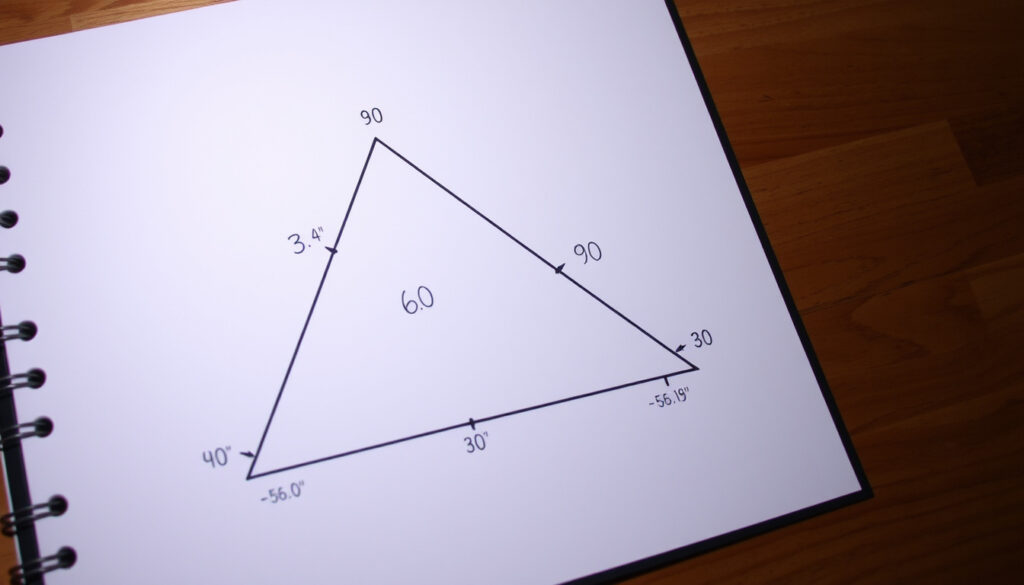
30-60-90 Triangle: Complete Guide to Rules and Calculations
If you’ve ever stared at a triangle and wondered why architects and engineers reach for the same ratios again and again, the 30-60-90 triangle is probably why. This particular shape shows up everywhere from roof pitches to ramp designs, and once you know the trick, calculating any missing side takes seconds instead of minutes.
Standard side ratio: 1 : √3 : 2 · Hypotenuse length: 2x (shortest leg ×) · Area formula: (x² √3)/2 · Sin 30°: 1/2
Quick snapshot
- Angles measure 30°, 60°, 90° (Omni Calculator)
- Ratios stay fixed at 1 : √3 : 2 (Khan Academy)
- Pythagorean check: 1² + (√3)² = 4 = 2² (CollegeVine)
- Specific real-world engineering examples beyond ramps or roofs
- Historical first documentation of the ratio
- Concept formalized in Euclidean geometry (~300 BC)
- Trigonometric verification came after 17th-century trig development
- Apply ratios to solve missing sides
- Use trig shortcuts for quick verification
| Property | Value |
|---|---|
| Angles | 30°, 60°, 90° |
| Side opposite 30° | x |
| Side opposite 60° | x√3 |
| Hypotenuse | 2x |
| Area example (x=1) | √3/2 ≈ 0.866 |
What Are the Rules for a 30-60-90 Triangle?
A 30-60-90 triangle is a right triangle with three fixed angles: 30°, 60°, and 90°. The side opposite the 30° angle is always the shortest, the side opposite 60° is the longer leg, and the side opposite 90° is the hypotenuse (Omni Calculator). What makes this triangle special is that the angles stay consistent in any size triangle, which means the ratios never change.
Angle measures
The three angles sum to 180°, with one right angle accounting for half that value. The 30° and 60° angles are complementary in the sense that they determine the proportions of the legs. This is the only right triangle where the three angles fall in arithmetic progression (Omni Calculator).
Side length ratios
The side opposite the 30° angle has length x, the side opposite 60° has length x√3, and the hypotenuse measures 2x (Khan Academy). This gives the universal ratio of 1 : √3 : 2 that holds regardless of how large or small the triangle is.
Pythagorean theorem verification
Testing the ratio against the Pythagorean theorem: 1² + (√3)² = 1 + 3 = 4, which equals 2² (CollegeVine). The math checks out perfectly, confirming these are true Pythagorean relationships even though 30-60-90 does not form a primitive triple since the GCD exceeds 1.
The implication is that students can bypass complex calculations entirely once they internalize these fixed relationships.
How Do You Calculate the Sides of a 30 60 90?
Knowing which side you have to start with determines your next steps. The key is identifying your known value, then applying the correct multiplier or divisor to find the other two sides (K12 Tutoring).
Given hypotenuse
If the hypotenuse measures c, divide by 2 to get the shortest leg (a = c/2), then multiply that result by √3 for the longer leg (b = c√3/2) (Omni Calculator). Example: if the hypotenuse is 14, the shortest side is 7 and the longer leg is 7√3 ≈ 12.12.
Given shortest leg
If the shortest leg measures a, double it to find the hypotenuse (2a) and multiply by √3 to find the longer leg (a√3) (Math.net). Example: if the shortest leg is 8, the hypotenuse is 16 and the other leg is 8√3 ≈ 13.86.
Given leg opposite 60°
If the longer leg (opposite 60°) measures b, divide by √3 to find the shortest leg (a = b/√3), then double the shortest leg to get the hypotenuse (Omni Calculator). This situation requires remembering that √3 ≈ 1.732, so b/1.732 gives the shortest side, then multiply by 2.
Students solving geometry problems should memorize three operations: multiply by 2, multiply by √3, divide by √3. Once these three are automatic, any missing side solves itself in seconds.
What this means for exam-takers is that speed and accuracy depend entirely on how instantly these three operations come to mind.
What Is the 30-60-90 Triangle Ratio?
The ratio 1 : √3 : 2 represents the proportional relationship between all three sides (Expii). Because the ratio is fixed, scaling any triangle by a factor k simply multiplies each side by k—the proportions remain identical.
Standard proportions
With the shortest leg as the base unit (typically denoted x), the sides are x, x√3, and 2x. The hypotenuse is exactly twice the shortest leg, and the longer leg is approximately 1.732 times the shortest leg (PrepScholar).
Scaling examples
If x = 5, the sides become 5, 5√3 ≈ 8.66, and 10. If x = 7, the sides are 7, 7√3 ≈ 12.12, and 14. The ratio holds no matter which positive value x takes (CollegeVine).
Comparison to 45-45-90
Unlike the 30-60-90 triangle, a 45-45-90 triangle is isosceles with equal legs and a hypotenuse of x√2. The 30-60-90 has unequal legs with a 1:√3 ratio, while the 45-45-90 has equal legs with a 1:1 ratio (Khan Academy). The 45-45-90 triangle’s angles are 45°, 45°, and 90°.
The 30-60-90 triangle derives from halving an equilateral triangle along its altitude, which immediately explains why those particular angles and ratios appear. No such geometric construction produces the 45-45-90 ratios.
The pattern is clear: the 30-60-90 triangle’s fixed proportions make it uniquely predictable compared to general right triangles.
What Is a 30-60-90 Triangle Used For?
The 30-60-90 triangle appears in practical contexts where specific angle slopes and proportions are required. Engineers and builders rely on these fixed ratios to ensure consistency across different scales (PrepScholar).
Real-world objects
Architectural ramps, certain roof pitches, and surveying equipment often use 30° or 60° angles. These angles create a comfortable slope for accessibility ramps while maximizing height per horizontal distance (K12 Tutoring). The equilateral triangle connection means any construction based on 60° angles can be analyzed with 30-60-90 geometry.
Engineering examples
Truss designs in bridge construction sometimes incorporate 30-60-90 triangles because they distribute load efficiently along the fixed proportions. Mechanical systems requiring precise angular positioning use these ratios for calibration purposes.
Trigonometry shortcuts
The 30-60-90 triangle provides pre-calculated trig values that eliminate the need for calculators in many scenarios. Sin 30° equals 1/2, cos 60° equals 1/2, tan 60° equals √3, and sin 60° equals √3/2 (Omni Calculator). These values appear repeatedly in physics and engineering problems.
Using 30-60-90 shortcuts saves time, but only if students first understand why the ratios work. Memorizing formulas without geometric reasoning creates fragile knowledge that fails when problems deviate from standard presentations.
What this means for learners is that shortcuts work best as reinforcement after grasping the underlying geometry.
30-60-90 Triangle Trig Ratios and Area
Trigonometric relationships confirm the side ratios through the definitions of sine, cosine, and tangent. Since sin(30°) = 1/2, the hypotenuse being twice the shortest leg follows directly from the sine formula (Omni Calculator).
Sin, cos, tan values
Using the standard setup where the shortest leg = 1: sin 30° = 1/2, cos 30° = √3/2, tan 30° = 1/√3. For 60°: sin 60° = √3/2, cos 60° = 1/2, tan 60° = √3. These values are worth memorizing since they appear constantly in trigonometry courses and standardized tests.
Area calculation
The area formula for a 30-60-90 triangle with shortest leg a is (a² √3)/2. With x = 1, the area equals √3/2 ≈ 0.866. For a shortest leg of 8, the area is (64 × √3)/2 = 32√3 ≈ 55.43 (Omni Calculator).
Missing side steps
To find a missing side when only one side is known: first identify which side type you have (short, long, or hypotenuse), then apply the appropriate transformation. The ratio 1:2 between the short leg and hypotenuse is the most frequently used relationship in solving problems.
The perimeter formula a(3 + √3) sometimes causes confusion because √3 appears twice in the calculation. Students should verify their work by checking that the Pythagorean theorem holds for the computed sides.
The implication is that verification through the Pythagorean theorem catches most calculation errors before they become problems.
30-60-90 vs 45-45-90 Triangle Comparison
Two special right triangles dominate geometry curricula: the 30-60-90 and the 45-45-90. Understanding their differences helps students choose the correct approach when solving problems.
| Property | 30-60-90 Triangle | 45-45-90 Triangle |
|---|---|---|
| Angles | 30°, 60°, 90° | 45°, 45°, 90° |
| Side ratios | 1 : √3 : 2 | 1 : 1 : √2 |
| Short leg to hypotenuse | 1 : 2 | 1 : √2 ≈ 1 : 1.414 |
| Leg relationship | Unequal (1 : √3) | Equal (1 : 1) |
| Trig values 30°/45° | sin 30° = 1/2 | sin 45° = √2/2 |
| Origin | Halved equilateral triangle | Halved square diagonally |
| Isosceles | No | Yes |
Four distinct properties separate these triangles: the 30-60-90 has unequal legs while the 45-45-90 is isosceles, the hypotenuse multiplier differs (2 vs √2), the trigonometric values for 30° differ from those for 45°, and their geometric origins are fundamentally different.
Step-by-Step: Finding Missing Sides
Follow these steps to find any missing side in a 30-60-90 triangle. Each scenario starts with a different given measurement, so identify your situation first.
- Identify the known side type: Determine whether you have the hypotenuse, shortest leg, or longer leg.
- Hypotenuse given: Divide the hypotenuse by 2 to get the shortest leg. Multiply the shortest leg by √3 to get the longer leg.
- Shortest leg given: Multiply by 2 to get the hypotenuse. Multiply by √3 to get the longer leg.
- Longer leg given: Divide by √3 to get the shortest leg. Double the shortest leg to get the hypotenuse.
- Verify with Pythagorean theorem: Check that (short)² + (long)² = (hypotenuse)².
When dividing by √3, remember that √3 ≈ 1.732. Rounding too aggressively can introduce errors that fail the Pythagorean check, so keep at least three decimal places during intermediate calculations.
The pattern is consistent across all three starting scenarios: once you identify the known side, the same three multipliers (×2, ×√3, ÷√3) unlock every calculation.
Expert Perspectives
The most important rule to remember is that this special right triangle has one right angle, and its sides are in an easy-to-remember consistent relationship with one another—the ratio is a : a√3 : 2a.
— Omni Calculator (mathematical tool developer)
Remembering the 30-60-90 triangle rules is a matter of remembering the ratio of 1 : √3 : 2. This ratio stays the same no matter how large or small the triangle is.
— PrepScholar (education blog)
The side lengths of a 30-60-90 triangle always have the ratio x : x√3 : 2x. This consistency regardless of scale is what makes these triangles so useful in standardized testing.
— Achievable (test preparation platform)
The pattern these sources emphasize is the same: once students internalize the 1 : √3 : 2 ratio, solving 30-60-90 problems becomes automatic pattern matching rather than step-by-step calculation.
Related reading: tallest buildings in architecture · historical timelines
When exploring 30-60-90 triangle calculations, a right angle triangle calculator proves invaluable for instantly solving sides, angles, and area alongside trig functions.
Frequently Asked Questions
Is 30-60-90 a Pythagorean triple?
No, 30-60-90 is not considered a primitive Pythagorean triple because the greatest common divisor of 1, √3, and 2 is greater than 1 when expressed in simplest radical form. However, multiplying by 2 gives sides 2, 2√3, 4, and multiplying by 4 gives 4, 4√3, 8, which follow the Pythagorean relationship: 1² + (√3)² = 4 = 2².
What real-world objects use 30 60 90 triangles?
Architectural ramps, certain roof pitches, surveying equipment, and structural trusses commonly incorporate these angles. The triangle derives from halving an equilateral triangle, which is why 60°-based constructions often involve 30-60-90 geometry.
How do I calculate the missing side of a triangle?
First identify which side you know: hypotenuse, shortest leg, or longer leg. If hypotenuse = c, then short leg = c/2 and long leg = c√3/2. If short leg = a, then hypotenuse = 2a and long leg = a√3. If long leg = b, then short leg = b/√3 and hypotenuse = 2b/√3.
What are sin cos tan values for 30-60-90 triangle?
For 30°: sin = 1/2, cos = √3/2, tan = 1/√3. For 60°: sin = √3/2, cos = 1/2, tan = √3. These values come directly from the side ratios where the shortest leg = 1.
How to find the area of a 30-60-90 triangle?
With shortest leg = a, the area equals (a × a√3)/2 = (a² √3)/2. For example, if a = 8, the area = (64 × √3)/2 = 32√3 ≈ 55.43. Using the formula with base and height also works: area = (base × height)/2.
How does 30-60-90 compare to 45-45-90 triangle?
The 30-60-90 has unequal legs (ratio 1:√3) and angles 30°-60°-90°, while the 45-45-90 is isosceles with equal legs (ratio 1:1) and angles 45°-45°-90°. The hypotenuse multipliers differ: 2 for 30-60-90 and √2 for 45-45-90.
What is the hypotenuse in a 30-60-90 triangle?
The hypotenuse is the side opposite the 90° angle, and it is always twice the length of the shortest leg (opposite the 30° angle). If the shortest leg measures x, the hypotenuse measures 2x.
For students preparing for geometry exams, the practical takeaway is straightforward: memorize three operations (multiply by 2, multiply by √3, divide by √3), verify with the Pythagorean theorem, and remember that the 30-60-90 triangle is simply a halved equilateral triangle with one altitude added. Practice with a few worked examples until the ratios feel automatic.
More related posts
 UC Berkeley Acceptance Rate 2025: 11.4% Stats & Tips
 Capital Gains Tax Calculator: How to Calculate CGT (Ireland & UK)
 YouTube TV Sign In – Step-by-Step Guide for All Devices
 New Movies to Stream 2024: Best Films on Netflix & Prime
 Best Queso Humacha Near Me: Types, Taste, and Guide
 How to Download Facebook Video : 4 Verified Method (2025 Guide)
 The Last Rodeo (2025): Cast, True Story & Where to Watch
 Men’s Haircuts Guide: Names, Styles, and How to Choose