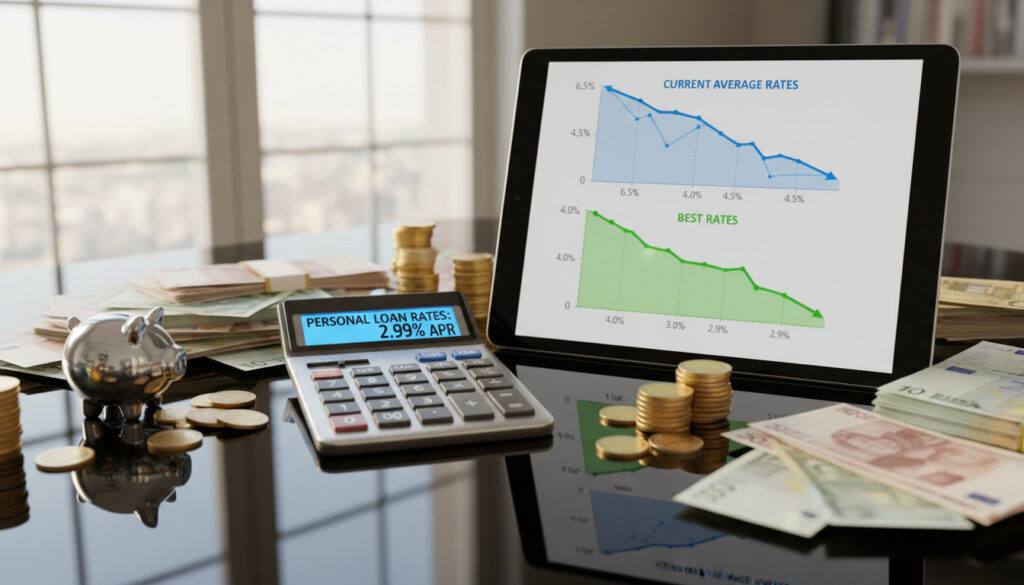
Personal Loan Interest Rates – Current Averages and Best Rates
Personal loan interest rates currently range from approximately 12% to 18.50% for qualified borrowers as of late March 2026, with the specific rate depending heavily on credit score and loan term. Three-year loans average 14.14% APR, while five-year terms sit at 18.50% on average. The broader market spans anywhere from 6% to 36% APR, creating significant variations in borrowing costs.
The disparity reflects risk-based pricing models used by lenders. Banks, credit unions, and online lenders assess creditworthiness through FICO scores, debt-to-income ratios, and payment history. Excellent credit borrowers with scores above 720 typically secure rates between 10% and 12%, while those with subprime scores below 630 face rates exceeding 20% and potentially reaching 36%.
Understanding these benchmarks matters for anyone considering debt consolidation, major purchases, or emergency financing. Even a two-percentage-point difference on a $20,000 loan can mean hundreds of dollars in additional interest over the repayment period. High Interest Savings Account US – Top Rates Compared offers context on how loan costs compare to current savings yields.
What Are the Current Average Personal Loan Interest Rates?
Current market data reveals a stratified landscape where borrower qualifications determine exact pricing. Aggregate figures show national averages clustering around 12% to 18.50%, though individual experiences vary significantly based on lender type and economic conditions.
Key market insights reveal the mechanics behind these numbers:
- Shorter repayment terms (36 months) carry lower rates than 60-month loans, averaging 14.14% versus 18.50% respectively
- Borrowers with excellent credit histories (720-850 FICO) access rates as low as 11.81% from major lenders
- The total market spectrum spans 6% to 36% APR, encompassing credit union specials to subprime offerings
- Rates fluctuate weekly based on Federal Reserve policy and funding costs
- Fixed-rate products dominate the market, representing approximately 95% of unsecured personal loans
- Credit unions typically offer rates 1-2 percentage points below traditional banks
- Prequalification checks with multiple lenders do not impact credit scores
| Metric | Current Value |
|---|---|
| National Average Range | 12% – 18.50% APR |
| 3-Year Loan Average | 14.14% |
| 5-Year Loan Average | 18.50% |
| Excellent Credit (720-850) | 11.81% – 12.50% |
| Good Credit (690-719) | 14.48% |
| Fair Credit (630-689) | 17.93% |
| Poor Credit (300-629) | 21.65% – 36% |
| 700 FICO Score (3-year, $5K) | 12.04% |
| Overall Market Range | 6% – 36% APR |
| Typical Loan Term | 24 – 60 months |
What Is a Good Interest Rate for a Personal Loan?
Defining “good” requires context about individual credit profiles and market conditions. For borrowers with excellent credit, rates below 12% represent competitive offers, while those with fair credit should view anything under 18% as favorable given current risk premiums.
Is 10% a Good APR?
A 10% APR qualifies as an exceptional rate in the current environment, generally reserved for borrowers with FICO scores above 750 seeking shorter terms. Credible’s market data indicates that excellent credit applicants can secure rates around 10% for three-year loans, particularly through credit unions or relationship banking channels. This sits well below the national average of 14.14% for similar terms.
What Credit Score Do You Need for the Best Rates?
The threshold for top-tier pricing typically begins at 720, though the most aggressive rates often require 740 or higher. NerdWallet’s analysis shows borrowers in the 720-850 range averaging 11.81% APR, compared to 14.48% for those in the 690-719 bracket. Each twenty-point increment in credit score generally correlates with measurable rate improvements.
Borrowers with FICO scores exceeding 720 should target rates between 10% and 12% APR. Falling within this range indicates competitive pricing relative to current market conditions for low-risk lending.
What Factors Affect Personal Loan Interest Rates?
Lenders algorithmically weigh multiple risk variables when assigning annual percentage rates. Credit score serves as the primary determinant, but secondary factors including debt burden, income stability, and loan characteristics significantly influence final offers.
How Credit Score Determines Your Rate
Credit scores function as predictive tools for default probability. Bankrate data demonstrates that borrowers with excellent credit (720+) receive rates averaging 11.81%, while fair credit borrowers (630-689) face rates near 17.93%. The spread widens further for subprime applicants, with some facing rates up to 36%.
The Role of Loan Term and Amount
Loan duration inversely correlates with interest rates. Three-year loans average 14.14% compared to 18.50% for five-year terms, reflecting the lender’s extended risk exposure. Smaller loan amounts sometimes carry higher rates due to fixed processing costs, though this varies by institution.
Lender Type and Market Conditions
Institutional categories create rate divergences. Credit unions like PenFed offer ranges from 6.09% to 17.99%, while major banks such as Wells Fargo post rates between 6.74% and 26.74%. Online aggregators facilitate comparison shopping, though rates fluctuate weekly based on Federal Reserve policy and funding costs.
Credit score remains the dominant factor, followed by debt-to-income ratio, income verification, and employment history. Loan term length and lender category (credit union versus bank) create secondary rate variations of 1-3 percentage points.
How Can You Get the Lowest Personal Loan Interest Rates?
Securing optimal rates requires strategic preparation and market navigation. Borrowers can manipulate several controllable variables to improve pricing, while understanding product structures helps avoid costly misunderstandings.
Are Fixed or Variable Rates Better?
The personal loan market predominantly operates on fixed-rate structures, with variable options remaining rare for unsecured products. Fixed rates provide payment predictability, shielding borrowers from Federal Reserve rate hikes. Current market analysis suggests variable-rate personal loans are scarce because lenders prefer the stability of fixed terms for unsecured credit.
How Do Personal Loans Compare to Credit Cards?
Personal loans typically offer substantial savings compared to revolving credit. While personal loan rates for good credit borrowers range from 11% to 15%, credit cards generally charge 15% to 25% variable APR. This differential makes personal loans preferable for debt consolidation or large, one-time expenses, whereas credit cards suit flexible, short-term borrowing.
Personal loans often beat credit card APRs by 5-10 percentage points for qualified borrowers. Carrying a $10,000 balance on a credit card at 20% APR costs significantly more than a personal loan at 12%, making loans preferable for debt consolidation despite origination fees.
To secure the lowest rates, borrowers should first check prequalification offers from multiple lenders without impacting credit scores. Improving credit scores above 720 through debt reduction and error correction unlocks top-tier pricing. Selecting shorter terms (three years versus five) and exploring credit union membership can reduce rates by 1-2 percentage points. Adding a co-signer with strong credit or establishing banking relationships may also yield preferential rates.
How Have Personal Loan Rates Changed Over Time?
Interest rate evolution tracks Federal Reserve policy and economic cycles. Recent years demonstrate significant volatility as monetary authorities adjusted benchmark rates to combat inflation.
- : Average rates hovered near 10.28% amid accommodative monetary policy and low federal funds rates.
- : Rates climbed to approximately 11.97% as the Federal Reserve implemented tightening measures.
- : Averages reached 12.65% reflecting sustained high-rate environment and increased lender risk premiums.
- : Current data shows 3-year loans averaging 14.14% and 5-year loans at 18.50%, representing a 0.43% recent weekly increase for shorter terms.
LendingTree historical data confirms these trends, showing consistent upward pressure as funding costs increased for lenders across the banking sector.
What Is Certain and Uncertain About Current Rate Data?
Distinguishing established facts from fluid market conditions helps borrowers set realistic expectations. While certain structural elements remain constant, daily pricing fluctuates based on macroeconomic variables. To understand these trends better, you can explore personal loan interest rates at $auto mechanic near me.
Established Information
- Credit score tiers directly determine rate ranges (720+ receives lowest APR)
- Three-year terms consistently price lower than five-year options
- Fixed-rate products dominate the unsecured personal loan market
- Credit unions generally offer lower rates than traditional banks
- Income verification and debt-to-income ratios impact final approvals
Information That Remains Unclear
- Daily rate adjustments by specific lenders (check official sites directly)
- Exact future movements tied to Federal Reserve policy decisions
- Individual qualification without prequalification (soft credit checks required)
- State-specific regulatory variations affecting local pricing
- Promotional rate expiration dates and renewal terms
Why Do Personal Loan Rates Vary Across Lenders and Borrowers?
Rate variations stem from risk-based pricing models and institutional cost structures. Lenders assess default probability using proprietary algorithms weighing credit history, income stability, and existing debt obligations. Those perceived as lower risk receive rates closer to the prime rate, while higher-risk borrowers face substantial risk premiums.
Economic factors including Federal Reserve policy, inflation expectations, and funding costs directly influence base rates. When the Fed maintains elevated rates (currently 5.25-5.50%), personal loan rates follow upward. Competition among banks, credit unions, and online lenders creates additional variation, with some institutions prioritizing market share over immediate profitability. Borrower-specific factors like employment sector, housing stability, and banking relationships further customize individual offers.
TSA Banned Costco Cards – Facts, Myths and Rules illustrates how regulatory and institutional policies can affect financial product availability, similar to how banking regulations influence loan pricing.
What Do Industry Data Sources Reveal About Personal Loan Rates?
Major financial data aggregators provide consistent benchmarks for rate expectations. Their methodologies involve daily monitoring of lender offers and borrower outcomes.
Current average personal loan interest rates range from about 12% to 18.50% depending on loan term and credit score, with shorter 3-year terms averaging 14.14% and longer 5-year terms reaching 18.50%.
— Credible Market Analysis, March 2026
Rates vary significantly by credit score, with borrowers in the 720-850 range seeing averages of 11.81%, while those with scores between 630-689 face rates near 17.93%.
— NerdWallet Personal Loan Research
Personal loans are predominantly fixed-rate, providing predictable payments, and typically beat credit card APRs which hover in the 15-25% range.
— Bankrate Lending Analysis
What Should Borrowers Do to Secure the Best Personal Loan Rate?
Prospective borrowers should begin by checking credit reports for errors and reducing outstanding debt to improve scores above 720. Prequalifying with at least three lenders—including credit unions, traditional banks, and online platforms—allows for apples-to-apples APR comparisons without credit damage. Selecting shorter repayment terms and exploring autopay discounts can further reduce rates. High Interest Savings Account US – Top Rates Compared provides additional context for comparing loan costs against current savings yields when evaluating financing decisions.
Frequently Asked Questions
How often do personal loan rates change?
Rates fluctuate weekly based on Federal Reserve policy, funding costs, and lender competition. Recent data showed a 0.43% increase for 3-year loans in late March 2026 alone.
What is the difference between APR and interest rate?
APR includes the interest rate plus any fees or origination charges, representing the true annual cost of borrowing. The interest rate alone does not account for these additional costs.
Can I get a personal loan with bad credit?
Yes, though rates range from 21.65% up to 36% for scores below 630. Some subprime borrowers may struggle to qualify, and rates near 36% approach credit card levels.
Does prequalifying affect my credit score?
No. Prequalification uses soft credit checks that do not impact scores. Only formal applications trigger hard inquiries that may temporarily reduce credit ratings by a few points.
Are credit union rates really lower than banks?
Generally yes. Credit unions like PenFed offer rates starting at 6.09% compared to major banks starting around 6.74%, with credit union averages typically running 1-2 percentage points lower for similar profiles.
Is 10% APR achievable for personal loans?
Yes, for borrowers with excellent credit (720+) seeking 3-year terms. Rates around 10-12% represent the current market floor for well-qualified applicants through credit unions or relationship banking.
Should I choose a 3-year or 5-year term?
Three-year terms offer lower rates (14.14% vs 18.50%) and less total interest, but higher monthly payments. Five-year terms provide cash flow relief at the cost of additional interest over time.
More related posts
 How Long Are You Contagious With the Flu? A Day-by-Day Timeline
 What Is a Nepo Baby? Definition, Richest, and Controversy
 Find the Best Empanada de Carne Cortada a Cuchillo Near Me
 Steelers vs Chargers 2025: Full Player Stats Breakdown
 Love Island New Season 2026: USA S8 Premiere, Cast & UK Update
 Men’s Haircuts Guide: Names, Styles, and How to Choose
 Is Black a Color – Science, Art and Perception Explained
 Best Deviled Egg Recipe: 5 Golden Rules & Secret Ingredients