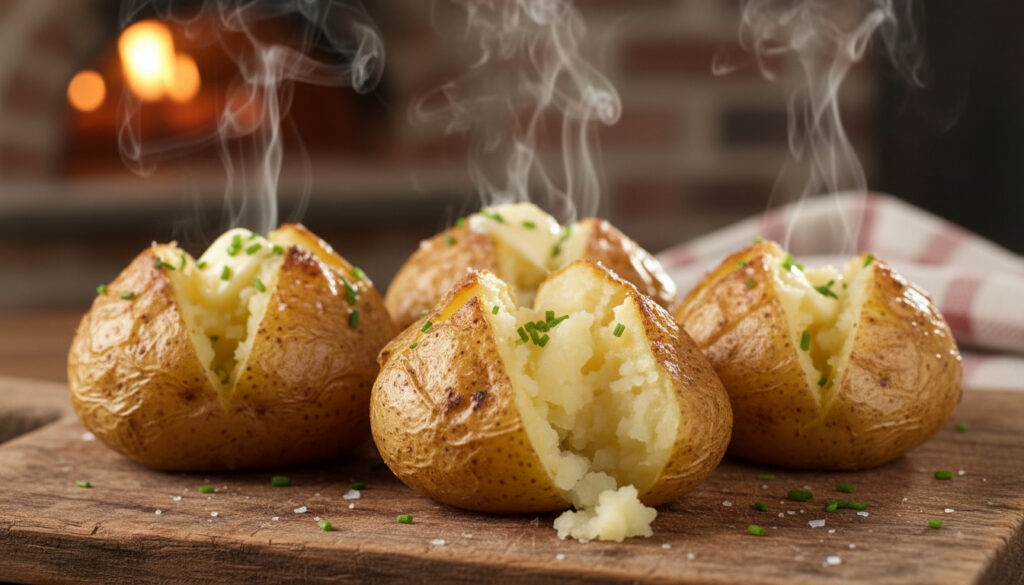
Baked Potatoes in Oven – Crispy Skin and Fluffy Inside
Achieving a fluffy interior and crackly skin requires more than simply placing potatoes in a hot oven. The method involves specific temperature control, proper preparation techniques, and understanding how heat interacts with starch content during the baking process.
Russet potatoes remain the gold standard for baking due to their low moisture and high starch content. When exposed to dry heat at the correct temperature, their thick skins develop a satisfying crunch while the flesh transforms into a light, airy texture suitable for various toppings.
How Long and at What Temperature to Bake Potatoes?
The relationship between time and temperature determines the final texture of both the skin and interior. While several temperature settings produce edible results, specific ranges optimize the contrast between crispy exterior and fluffy center.
Several factors influence the precise timing required for optimal results:
- Russet varieties produce the fluffiest interior texture due to higher starch content and thicker skin.
- An oven temperature of 400°F balances efficient cooking with reduced risk of burning or drying.
- Digital thermometers reading 205-210°F confirm complete starch gelatinization.
- Convection settings reduce baking duration by approximately 5 to 10 minutes.
- Direct rack exposure without foil promotes moisture evaporation essential for crisp skin.
- Rotation at the halfway point ensures uniform heat distribution around the tuber.
- Resting for five minutes post-baking allows internal temperature to stabilize and moisture to redistribute.
The following table provides specific timings based on potato size and oven configuration:
| Size Category | Weight | Temperature | Duration | Target Internal Temp |
|---|---|---|---|---|
| Small | ~6 oz | 400°F | 35-40 min | 205-210°F |
| Medium | 6-8 oz | 400°F | 45-50 min | 205-210°F |
| Large | 8-12 oz | 400°F | 60-65 min | 205-210°F |
| Extra Large | 12+ oz | 400°F | 75+ min | 205-210°F |
| Medium | 6-8 oz | 425°F | 50-60 min | 205-210°F |
| Medium | 6-8 oz | 400°F Convection | 40-45 min | 205-210°F |
| Medium | 6-8 oz | 350°F | 60-70 min | 205-210°F |
Testing doneness requires inserting a fork or paring knife; the utensil should penetrate with minimal resistance, sliding through the flesh with butter-like smoothness. Detailed temperature guidelines emphasize that visual cues alone prove insufficient for consistent results.
How to Prepare Potatoes Before Baking
Selecting the Right Potato Variety
Russet potatoes, often labeled as Idaho bakers, outperform waxy varieties for oven baking. Their low moisture content and dense starch matrix create the characteristic fluffy interior, while the thick skin develops substantial texture when exposed to high heat. Yukon Gold or red potatoes contain higher moisture and waxy textures that produce denser, creamier results less suited to traditional baked potato expectations.
Cleaning and Piercing Techniques
Scrubbing under running water removes residual soil from the skin’s crevices. Complete drying with a towel proves essential; surface moisture inhibits crisping by lowering the skin temperature during initial baking phases. Preparation methods recommend poking six to twelve shallow holes across the potato’s surface using a fork tine.
Poking holes creates escape routes for steam generated during heating. Without these perforations, internal pressure buildup can cause potatoes to burst, releasing starch and moisture that compromise both texture and oven cleanliness.
To Wrap or Not to Wrap?
Aluminum foil creates a sealed environment that traps evaporating moisture against the potato surface. This steaming effect produces soft, leathery skin rather than the desired crispy texture. Baking duration recommendations specify placing potatoes directly on the oven rack or on a wire rack positioned over a baking sheet to maximize airflow exposure.
Step-by-Step: Best Way to Bake Potatoes in the Oven
Oiling and Seasoning for Crispy Skin
Applying approximately one-half tablespoon of olive oil or neutral high-smoke-point oil per potato creates a barrier that promotes browning. The oil helps coarse kosher salt adhere to the skin surface; this salt layer draws out surface moisture while creating a textured crust. While skipping oil and salt reduces caloric content, the resulting skin lacks the textural contrast that defines restaurant-quality baked potatoes.
Rack Placement and Airflow
Positioning the potatoes directly on the center oven rack exposes all surfaces to radiant heat evenly. Placing a baking sheet on the rack below catches any drips of oil or salt. Alternatively, arranging potatoes on a cooling rack set inside a foil-lined baking sheet elevates them for improved air circulation beneath.
Covering potatoes with aluminum foil or wrapping them individually before baking traps moisture against the skin. This method steams rather than bakes the potato, resulting in softened skin texture inconsistent with crispy outcomes.
Recognizing Completion
Visual indicators such as skin wrinkling or slight browning suggest approaching doneness, but internal temperature provides definitive measurement. A digital instant-read thermometer inserted into the center should register between 205°F and 210°F. At this temperature, starch granules have fully absorbed water and burst, creating the characteristic fluffy texture.
Variations for Oven-Baked Potatoes
Sweet Potato Adaptations
Sweet potatoes require similar preparation steps but exhibit denser flesh requiring adjusted timing. Medium specimens weighing six to eight ounces typically need 45 to 55 minutes at 400°F, while larger sweet potatoes may require 55 to 70 minutes. The skin crisps effectively without foil, though the interior remains moister than russet equivalents due to higher sugar and water content.
Convection ovens circulate hot air more efficiently than conventional thermal ovens, reducing required baking time by approximately 5 to 10 minutes at 400°F. Monitor closely during the final quarter of estimated cooking time to prevent over-drying.
Alternative Temperature Options
While 400°F represents the standard for balanced results, higher temperatures accelerate skin crisping. Baking at 425°F reduces cooking time but requires closer monitoring to prevent burning. Lower temperature approaches using 350°F extend duration beyond one hour but minimize burning risk for those preferring softer skin textures.
What Is the Timeline for Baking Potatoes?
The complete process from raw ingredient to finished dish follows a predictable sequence:
- Preparation: Scrubbing, drying, piercing, and oiling requires approximately 5 to 10 minutes depending on quantity.
- Baking: The primary cooking phase lasts 45 to 75 minutes based on potato size and oven temperature.
- Resting: A five-minute rest period allows internal temperatures to equilibrate and starches to set.
- Serving: Splitting and topping adds 2 to 3 minutes before consumption.
What Is Definite and What Remains Variable?
Certain aspects of oven baking rest on established culinary science, while others depend on specific equipment and environmental factors.
| Established Facts | Variable Factors |
|---|---|
| Russet potatoes produce the fluffiest interior due to starch composition | Exact timing varies by individual oven calibration and hot spots |
| 400°F provides optimal balance of crisping and cooking speed | Ambient humidity affects surface moisture evaporation rates |
| Internal temperature of 205-210°F indicates complete starch gelatinization | Potato density varies by growing conditions and storage duration |
| Foil traps moisture and prevents skin crisping | Resting time precision depends on serving temperature preferences |
| Poking holes prevents steam-pressure rupturing | Oil absorption rates differ based on skin texture variations |
Why Does Oven Baking Produce Superior Texture?
Dry heat baking operates through fundamentally different mechanisms than moist-heat methods. Microwave cooking steams the potato from within, producing dense, uneven textures and chewy skins. Boiling or foil-wrapped baking introduces external moisture that limits the Maillard reaction responsible for browning and flavor development.
The oven’s dry environment allows surface moisture to evaporate rapidly once temperatures exceed 300°F. This dehydration concentrates surface starches that then brown and crisp. Simultaneously, the gradual heating of the interior converts dense starch granules into light, expanded structures capable of absorbing butter and toppings effectively.
From a nutritional perspective, baking with skin intact preserves water-soluble vitamins and minerals, including significant potassium content. A medium baked potato contains approximately 160 calories with negligible fat unless added during topping preparation.
Expert Perspectives on Oven Baking Methods
Culinary specialists emphasize the importance of dry surfaces and direct heat exposure for achieving steakhouse-quality results at home.
“The salt draws moisture from just beneath the skin surface, creating a micro-layer that dries and crackles during the final baking minutes. This textural contrast defines the perfect baked potato.”
— Culinary Technique Analysis, Savory Experiments
“Temperature verification trumps timing assumptions. Every oven behaves differently, and potato density varies by season. The fork test remains the home cook’s most reliable tool when thermometers prove unavailable.”
— Cooking Duration Research, The Short Order Cook
What Are the Essential Steps for Success?
Consistent results depend on selecting appropriate potato varieties, maintaining dry surfaces before oil application, avoiding moisture-trapping foil, and verifying internal temperatures reach 205°F before serving. For comprehensive preparation techniques, refer to Baked Potatoes in the Oven. Precise timing guidelines for specific weights and oven configurations appear in How Long to Bake Potatoes at 400.
Common Questions About Oven Baking
Can baked potatoes be prepared without aluminum foil?
Yes, eliminating foil produces superior crispy skin. The foil-free method exposes the potato surface to dry heat, allowing moisture evaporation essential for textural contrast.
Do potatoes require piercing before baking?
Poking six to twelve holes prevents steam pressure buildup that causes potatoes to burst during cooking. This step protects both the food and oven interior from starch explosions.
How can I tell when a baked potato is fully cooked?
Insert a digital thermometer into the center; 205-210°F indicates completion. Alternatively, a fork should penetrate with no resistance and slide out easily without lifting the potato.
Are oven-baked potatoes healthy?
Baked potatoes contain significant potassium, vitamin C, and fiber when consumed with skin. A plain medium potato contains approximately 160 calories, though toppings add substantial fat and caloric content.
Can sweet potatoes use the same baking method?
Sweet potatoes follow similar preparation steps but require 45-55 minutes for medium sizes due to denser flesh. The skin crisps without foil, though interiors remain moister than russet varieties.
How should leftover baked potatoes be stored?
Refrigerate cooled potatoes in airtight containers within two hours of cooking. Consume within three to four days, reheating in a 350°F oven for 15-20 minutes to restore crispy skin texture.
Why is my baked potato skin not crispy?
Excess surface moisture, foil wrapping, or insufficient oil application typically cause soft skin. Ensure potatoes are thoroughly dried after washing, baked directly on the rack, and coated with oil and salt before heating.
More related posts
 If We Were Villains – Plot Summary, Characters and Ending Guide
 Where to Watch The Office: Streaming in 2025
 Trump Social Security Transparency Initiatives: 2025 Plan
 Real Women Have Curves: True Story, Plot, Cast & Where to Watch
 One Piece Live-Action Cast: Full List & Season 2 Updates
 Cast of We Were Liars: Full Character Guide & Cancellation
 Golden Corral Near Me – Locations, Prices, Menus & Hours
 It Ends With Us: Book, Movie, and Controversy Explained