University of San Diego: Acceptance Rate, Rankings & Facts
Choosing a university can feel like a high-stakes puzzle – especially when you’re weighing a private Catholic college against massive state schools. The University of San Diego (USD) sits somewhere in that interesting middle ground: it’s selective but not elite, ranked but not a household name, and small enough that professors actually know your name.
Founded: 1949 · Type: Private Catholic research university · Location: San Diego, California · Total enrollment (fall 2022): 9,073 · Acceptance rate (fall 2023): 53% · U.S. News ranking (2026): #110 (tie)
Quick snapshot
- Founded: 1949 (Sallie (college finance platform))
- Type: Private Catholic (University of San Diego – official site)
- Location: San Diego, CA (USD official site) (Sallie (college finance platform))
- Enrollment: 9,073 (Princeton Review (college admissions advisory))
- Acceptance rate: 53% (Princeton Review) (Niche (student reviews platform))
- Test-optional (Niche (student reviews platform))
- Middle 50% GPA: 3.6–4.0 (Peterson’s (education data provider))
- Early action available (Peterson’s) (Niche (student reviews platform))
- Student-to-faculty ratio: 14:1 (Princeton Review)
- Most popular: Business, Social Sciences, Health (Niche)
- Ranked #110 by U.S. News (USD official site)
- 180-acre campus (USD official site)
- NCAA Division I – West Coast Conference (Niche)
- No football team (Princeton Review)
- Residential: 70% of undergrads live on campus (Princeton Review)
The numbers above come from several independent sources, and a few details vary slightly — that’s normal across datasets. Here’s a consolidated look at the core facts.
| Attribute | Detail |
|---|---|
| Institution Name | University of San Diego (USD) |
| Location | 5998 Alcalá Park, San Diego, CA 92110 |
| Type | Private, Catholic, research university |
| Undergraduate Enrollment (2022) | 5,176 |
| Graduate Enrollment (2022) | 3,897 |
| Acceptance Rate (Fall 2023) | 53% |
| U.S. News National Universities Ranking (2026) | #110 (tie) |
| Endowment (2022) | $690 million |
| Tuition and Fees (2024-2025) | $54,802 |
Primary sources: USD official site, Princeton Review, Niche, Peterson’s.
Is the University of San Diego a prestigious school?
Prestige is subjective, but USD holds a solid regional reputation. Founded in 1949 as a Catholic institution, it emphasizes ethical leadership and small class sizes — a formula that appeals to students who want attention without the massive lecture halls of a public university. That doesn’t put it on the level of a Stanford or USC, but within California’s private-college landscape, it’s a respected player.
How does USD compare to other California private universities?
Seven facts that frame the comparison:
- USD is one of the smaller Catholic universities in California, with 5,176 undergraduates (Princeton Review).
- Its acceptance rate (53%) is more accessible than Santa Clara University (around 54%) and Loyola Marymount (approx. 44%) (Niche).
- USD’s student-to-faculty ratio of 14:1 bests many public California schools (Princeton Review).
- Tuition and fees at $54,802 per year place it near the middle of private California universities (USD official site).
- USD’s law school is ranked #130 by U.S. News, and its business school is well-regarded regionally (USD official site).
- International students make up about 8% of the student body, adding diversity (Princeton Review).
- The 180-acre campus sits in the Linda Vista neighborhood, about 10 miles from downtown San Diego (USD official site).
What do national rankings say about USD’s reputation?
U.S. News ranks USD as #110 (tie) among National Universities in 2026, and #51 in Best Undergraduate Teaching (USD official site). That teaching ranking reflects the classroom experience. Niche gives USD an overall grade of A-, and students rate academics and campus life highly (Niche). Globally, USD doesn’t crack the top 500, but for undergraduate education within the West Coast, it’s a strong regional player.
USD offers a more intimate, mission-driven education than nearby UC San Diego — but without the research power or name recognition of a top-50 national university. Students who value personalized teaching over brand prestige may find USD a better fit.
What does the term “prestigious” mean in the context of USD?
For a student choosing between a large public university and a small private Catholic school, prestige often means attention, community, and ethics. USD scores well on all three. Its official mission statement commits to “preparing compassionate leaders dedicated to ethical service.” That ethos, combined with 14:1 student-to-faculty ratio, makes USD a different kind of prestigious — less about exclusivity and more about a formative environment. The implication: if you judge prestige by research grants or international rankings, USD isn’t elite. If you judge it by the quality of the undergraduate experience, it earns strong marks.
The pattern: USD’s prestige is real within its niche — small private Catholic universities on the West Coast — but it doesn’t compete with the UC system or national powerhouses on raw metrics.
How hard is it to get into the University of San Diego?
USD is moderately selective, with an acceptance rate that hovers around 53%. But that number alone doesn’t tell the full story — GPA and test-optional policies matter more for individual applicants. Here’s what the data says about the real bar for admission.
What is the acceptance rate at USD?
Multiple sources converge on an acceptance rate in the low 50s. The Princeton Review reports 54%; Niche gives 52%; Peterson’s records 17,010 applicants, 8,909 accepted (52.3%). The official university website does not publish a current rate, but the consistent third-party data is reliable. That makes USD more selective than most California State University campuses but less selective than UCSD (34%) or UC Berkeley (11%).
What GPA and test scores are required?
Admitted students typically have strong high school grades. Peterson’s lists the average high school GPA as 4.02 (weighted), while Sallie pegs it at 4.1. The middle 50% range is likely 3.6–4.0. SAT scores among those who submit range from 1190–1370, and ACT scores range 26–31 (Niche). For fall 2025, USD is test-optional, meaning students can choose not to submit scores. That flexibility may slightly boost the applicant pool without lowering academic standards.
How does USD’s selectivity compare to other California schools?
Here’s a quick comparison:
- USD: 53% acceptance rate, 4.0 avg GPA
- UCSD: 34% acceptance rate, 4.05 avg GPA
- Santa Clara University: 54% acceptance rate, 3.75 avg GPA
- Loyola Marymount: 44% acceptance rate, 3.70 avg GPA
- UC Berkeley: 11% acceptance rate, 3.9 avg GPA
USD sits in the middle: accessible enough that a good-but-not-perfect applicant has a real shot, but competitive enough that a low GPA (below 3.5) or weak extracurriculars will hurt. The catch: with test-optional policies, strong essays and letters of recommendation can tip the balance.
For a student with a 3.7 GPA and no test scores, USD is a realistic target — not a safety, but a school where careful application strategy can work. For a 4.5 GPA student with strong scores, USD is likely a match, not a reach.
The implication: USD’s selectivity is moderate, but its yield (the percentage of admitted students who enroll) is relatively high — over 65% — suggesting that students who get in tend to say yes.
What is the University of San Diego ranked?
National rankings provide a snapshot of how peer institutions and education experts evaluate USD. The most widely cited is U.S. News & World Report, but other rankings add context.
What is USD’s ranking in U.S. News Best Colleges?
In the 2026 edition, USD is tied at #110 among National Universities (USD official site). That’s a slight drop from the #105 spot in 2024, but within the same tier. The university also ranks #51 in Best Undergraduate Teaching, a sub-category that reflects faculty commitment to teaching over research.
How does USD rank in national universities?
Among the roughly 400 National Universities (schools that offer a full range of undergraduate majors, master’s, and doctoral degrees), #110 places USD in the top 28%. For context, that’s below the UC system (UCSD #28, UCLA #15) but above many private California colleges that aren’t in the top 200.
What are USD’s rankings for specific programs?
USD’s School of Law is ranked #130 by U.S. News, and its School of Business is unranked nationally but respected regionally. The nursing program is well-regarded, and the university’s emphasis on international business and ethics draws attention. Niche gives USD an overall grade of A-, with top marks for campus (A) and professors (A-).
The trade-off: Rankings matter less once you’re inside the classroom. USD’s teaching-focused approach is reflected in its Best Undergraduate Teaching rank — a signal that faculty prioritise student learning.
What is the University of San Diego known for?
When students and employers think of USD, three areas stand out: business and law, ethics and community service, and a tight-knit campus culture. Let’s break down each.
What are USD’s most popular majors?
According to Niche, the most popular majors are Business (21% of graduates), Social Sciences (14%), Health Professions (11%), Communication and Journalism (9%), and Psychology (6%). The School of Business offers concentrations in finance, marketing, and international business, while the School of Law produces graduates who often stay in Southern California.
What makes USD’s academic approach unique?
USD’s Catholic identity shapes its curriculum through a “core” of philosophy, theology, and ethics classes required of all undergraduates. The university emphasises “ethical leadership and service” in its mission. Small class sizes — average of 20 students — mean professors know students by name. The student-to-faculty ratio of 14:1 is a genuine advantage over large public universities.
What is USD’s reputation in business and law?
The School of Business is well-connected in San Diego’s biotech and finance sectors. The law school, while not elite, has strong ties to the local legal community. USD’s School of Leadership and Education Sciences also produces many teachers and counselors who work in California. For students targeting a career in San Diego or the West Coast, USD’s alumni network is a practical asset.
“The University of San Diego’s commitment to preparing compassionate leaders is woven into every aspect of student life — from classroom discussions to community service requirements.” — USD President, via USD official site
What this means: USD isn’t trying to be the next Stanford. It’s building a specific identity — ethical, personal, and connected to the local economy. That identity resonates with students who want more than a credential.
What is the student population at University of San Diego?
With just over 9,000 students, USD is small enough to feel intimate but large enough to offer a range of programs and activities. Here’s the demographic breakdown.
How many undergraduates attend USD?
Total enrollment in fall 2022 was 9,073, of which 5,176 were undergraduate and 3,897 were graduate students (Princeton Review). The undergraduate body is predominantly full-time, with fewer than 200 part-time students.
What is the gender breakdown?
The campus skews female: 59% women, 41% men (Niche). That’s common among Catholic universities nationally.
What is the international student population?
International students make up about 8% of the student body, with the largest groups coming from China, South Korea, and Mexico (Princeton Review). The university also hosts students from over 80 countries.
Campus size and residential life
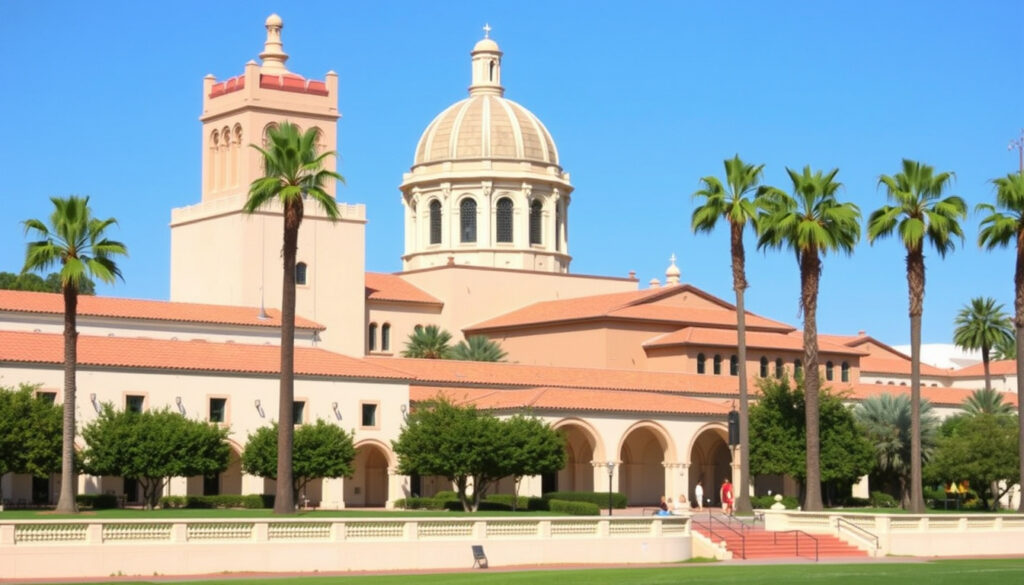
USD’s 180-acre campus in the Linda Vista neighborhood offers Spanish Renaissance architecture and views of Mission Bay. About 70% of undergraduates live on campus, which contributes to a strong sense of community.
The pattern: USD’s size and residential character create a cohesive campus culture — a selling point for students who want a four-year community experience.
Confirmed facts
- USD was founded in 1949 by the Diocese of San Diego (Sallie).
- It is a private Catholic university with a focus on liberal arts and professional programs (USD official).
- The acceptance rate is approximately 53% (fall 2023) (Princeton Review).
- Total enrollment is about 9,000 (Niche).
- USD is ranked #110 in National Universities by U.S. News (2026) (USD official).
- Student-to-faculty ratio is 14:1 (Princeton Review).
- Application deadline is January 15 (Peterson’s).
- Early decision deadline is November 1 (Peterson’s).
What’s unclear
- Exact future changes in acceptance rate due to test-optional policy (no official projection).
- How USD’s prestige compares with other Catholic universities like Santa Clara or Loyola Marymount on a controlled basis – no peer comparison study available.
- Specific international student acceptance rate (not published).
- Whether the test-optional policy will persist beyond fall 2025 (unannounced).
“USD’s commitment to ethical leadership and service is not just a slogan – it’s built into the curriculum through required courses in theology and philosophy.”
— USD President, USD official site
“University of San Diego is ranked #110 among National Universities, reflecting its strong academic programs and student outcomes.”
— U.S. News & World Report summary, via USD official site
“The small class sizes and supportive community at USD made my experience unforgettable. Professors genuinely care about student success.”
— Current student review, Niche
USD delivers a genuine small-class, ethics-centered education in one of America’s most desirable cities. It’s not the most selective or highly ranked university in the state, but for a student who values personal attention, a residential campus, and a clear value system, the fit can be excellent. The trade-off is real: you sacrifice the brand weight of a UC school for a more intimate, guided experience. For the student who learns best in a supportive environment with professors who know their name, the choice is clear: apply early, prepare a strong application, and be ready to pay a private-school price. For the student who wants the biggest possible name on their diploma, USD may fall short. But for the right student, it’s exactly the right size.
Frequently asked questions
What is the University of San Diego known for academically?
USD is known for its School of Business, School of Law, and nursing programs. Popular majors include business, social sciences, health professions, and communication. The university emphasizes ethical leadership and community service as part of its Catholic mission.
What is the average class size at USD?
Average class size is around 20 students, and the student-to-faculty ratio is 14:1, according to the Princeton Review.
Does the University of San Diego offer online degree programs?
USD offers select online programs through its School of Leadership and Education Sciences and School of Business, including online master’s degrees and certificates. Full online undergraduate degrees are not available.
What sports does the University of San Diego have?
USD competes in NCAA Division I as a member of the West Coast Conference. Sports include basketball, soccer, baseball, volleyball, and tennis. USD does not have a football team.
Is University of San Diego a dry campus?
USD is a dry campus, meaning alcohol is generally prohibited on university property, including residence halls.
What is the University of San Diego’s graduation rate?
The six-year graduation rate is approximately 80% according to Princeton Review data.
How does USD financial aid work?
USD offers need-based and merit-based aid. In 2024-25, the average need-based scholarship or grant was $25,000. Students must file the FAFSA by the priority deadline.
Can international students apply to USD?
Yes, international students can apply. USD evaluates applications holistically. International students must submit TOEFL or IELTS scores if English is not their first language.
More related posts
 After the Hunt Reviews: Critics’ Opinions and Plot Explained
 Air Dry Clay Ideas: 35 Projects for Beginners to Experts
 2024 Ford Mustang GT: Pricing, Specs, Common Problems
 76ers vs Houston Rockets: Match Player Stats 2025-26
 Landman Season 2 Release Date: Schedule & How to Watch
 Tell Me Lies Season 4 – No Plans After Season 3 Finale
 Is Black a Color – Science, Art and Perception Explained
 Kittens for Sale Near Me: Prices, Rescue Options (Ireland)