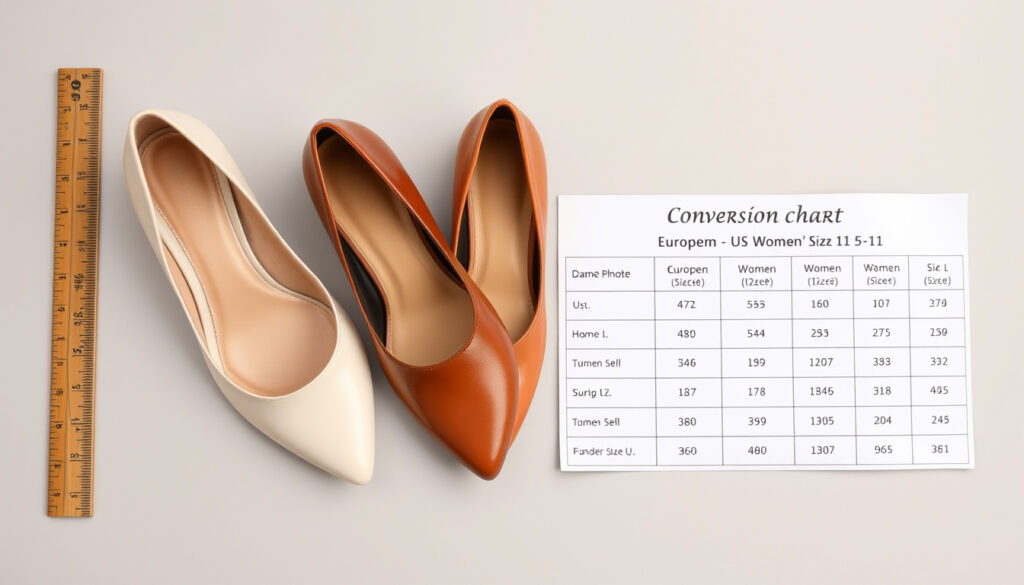
Euro Shoe Size to US Women’s: Conversion Chart for Sizes 5–11
Anyone who’s ever tried to buy shoes online from a European brand knows the moment of hesitation: “Is a 38 my size?” The answer isn’t as simple as adding or subtracting a fixed number — it depends on the brand, the last, and sometimes even the shoe style. Here’s a fact-grounded breakdown of how EU women’s shoe sizes map to US sizes 5–11, with specific brand charts and the real-world variance you need to watch for.
US 5 → EU 35–36 ·
US 8 → EU 38–39 ·
US 10 → EU 40–41
Quick snapshot
- US women’s 5 = EU 35–36 in general conversion charts (Shoe-Inn (specialty footwear retailer))
- Veronica Beard maps US 5 to EU 35 exactly (Veronica Beard (designer footwear brand))
- Nike advises measuring both feet and using the longer length (Nike (athletic footwear manufacturer))
- Whether a “whole-size” EU number (e.g., EU 39) maps to US 8 or US 8.5 — varies by brand (Shoe-Inn (specialty footwear retailer))
- Half EU sizes (e.g., EU 38.5) are not present in all brand charts, creating ambiguity for US 8 (Veronica Beard (designer footwear brand))
- Flow Feet highlights the complexity of US-to-EU conversions, noting that women’s US sizes differ significantly from men’s (Flow Feet (specialty footwear retailer))
- Expect more brands to adopt half-size EU options for better fit (ECCO (footwear manufacturer with in-store fitting expertise))
- Standardized heel-to-toe measurement (as recommended by ECCO (footwear manufacturer with in-store fitting expertise)) may reduce confusion
EU to US Women’s Size Conversion at a Glance
The seven most common US women’s sizes from 5 to 11 show a clear pattern: each US whole size typically spans a range of two EU numbers, but the exact midpoint varies by brand. Here’s how the major references line up.
| US Women’s | EU Range (general) | Veronica Beard | ECCO / Standard |
|---|---|---|---|
| 5 | 35 – 36 | 35 | 35 – 36 |
| 6 | 36 – 37 | 36 | 36 – 37 |
| 7 | 37 – 38 | 37 | 37 – 38 |
| 8 | 38 – 39 | 38.5 | 38 – 39 |
| 9 | 39 – 40 | 40 | 39 – 40 |
| 10 | 40 – 41 | 41 | 40 – 41 |
| 11 | 41 – 42 | 42 | 41 – 42 |
What this means: The biggest discrepancy appears at US size 8 — Veronica Beard uses EU 38.5 (a half-size) while general charts show 38–39. If you’re a solid US 8, you may need a half EU size that many European brands don’t offer.
Why Brand-Specific Charts Matter More Than General Rules
Relying on a one-size-fits-all conversion is the fastest route to a return label. Every brand constructs its lasts differently — the foot-shaped mold around which the shoe is built.
- Veronica Beard uses a unique last that maps US 7 to EU 37 and US 8 to EU 38.5 (Veronica Beard (designer footwear brand)). This means a US 8 customer who orders EU 39 in another brand may get a shoe that’s half a size too long.
- ECCO recommends a paper-and-pencil measurement method and then matching the longer foot to its own chart (ECCO (global shoe manufacturer with proprietary fit system)). Their women’s chart shows US 5 as EU 35–36, but the exact fit can shift by style.
- Nike publishes a separate size chart for women and advises using the measurement of the longer foot; if between sizes, go up (Nike (leading athletic footwear company)).
The pattern: When a brand publishes its own conversion table, follow it — not a generic internet cheat sheet. The catch is that not all brands show half-EU sizes, so a true US 8.5 may have to choose between slightly snug EU 38 or slightly loose EU 39.
How to Measure Your Foot for the Most Accurate Conversion
Before you look at any size chart, get your foot length in centimeters. EU sizing is based on a continental scale where each whole size equals roughly two-thirds of a centimeter (Grivet Outdoors (outdoor gear retailer)). Here’s the method recommended by two sources.
- Trace and measure: Place a piece of paper on a hard floor, stand on it with your heel against the wall, and mark the longest toe. Measure from the edge of the paper to the mark in centimeters (ECCO).
- Measure both feet: One foot is almost always longer. Use the longer foot’s measurement when selecting a size (Nike (athletic footwear manufacturer)).
- Check the brand’s cm-to-EU conversion: Many EU shoe size charts list foot length in centimeters alongside the EU number. For example, a foot length of 23 cm usually corresponds to EU 36 (Shoe-Inn (specialty footwear retailer)).
A half-centimeter measurement error can push you a whole EU size off. For size 8 buyers (the most returned size in women’s shoes), measuring in cm before consulting a brand chart cuts the guesswork dramatically.
The implication: Measuring in centimeters is the most reliable way to bypass conversion uncertainty, especially for size 8 buyers.
Confirmed Facts vs. What’s Still Unreliable
Confirmed facts
- US 5 → EU 35–36, US 6 → EU 36–37, US 7 → EU 37–38, US 8 → EU 38–39, US 9 → EU 39–40, US 10 → EU 40–41, US 11 → EU 41–42 according to general industry charts (Flow Feet (specialty footwear retailer))
- Veronica Beard’s chart differs: US 8 uses EU 38.5, US 9 uses EU 40 (Veronica Beard (designer footwear brand))
- ECCO and Nike both advise using foot-length measurement for best fit (ECCO (global shoe manufacturer with proprietary fit system); Nike (athletic footwear manufacturer))
What’s unclear
- Grivet Outdoors’s text conversion reportedly lists US 10 as EU 43, which conflicts with every other source — likely a chart error or misread (Grivet Outdoors (outdoor gear retailer))
- Whether US half-sizes (e.g., 7.5, 8.5) have consistent EU equivalents across brands — no universal standard exists
- Some brands skip half-EU sizes entirely, leaving customers without a precise match
The pattern: Brand-specific charts are essential for accurate sizing, but the lack of half-EU sizes in many brands leaves a gap for US half-size wearers.
Expert Perspectives on Sizing Variance
“A US women’s size 5 commonly corresponds to EU 35 or 35–36, depending on the brand.”
— Shoe-Inn (specialty footwear retailer with dedicated conversion resources)
“ECCO recommends measuring the foot from heel to toe with paper, pencil, and ruler, then matching the longest foot to the size chart.”
— ECCO (global footwear brand with in-store and at-home fitting guides)
Two brands, two approaches — both underline the same reality: there is no single EU–US conversion that works for every pair of shoes. The only reliable path is brand-specific measurement.
For those shopping across the Atlantic, understanding the UK to EU shoe conversion can help avoid sizing mistakes when ordering from European brands.
Frequently asked questions
What EU size is a US women’s 5?
Most charts show EU 35–36. Veronica Beard maps it exactly to EU 35. Always check the brand’s own chart.
What EU size is a US women’s 8?
Generally EU 38–39, but Veronica Beard uses EU 38.5. If you’re between sizes, go up to EU 39.
Why do different brands show different EU sizes for the same US size?
Each brand designs its shoes around a different “last” (foot mold). The same US size can correspond to different foot lengths in centimeters across brands.
How do I measure my foot for EU shoe size?
Stand on a piece of paper against a wall, mark the longest toe, measure heel-to-toe in centimeters, then consult the brand’s cm-to-EU chart.
What if my foot measurement falls between two EU sizes?
Nike advises sizing up. If the brand uses half-EU sizes (e.g., 38.5), that’s the safest choice. Otherwise choose the larger whole size.
Do EU sizes use half sizes?
Some brands offer half sizes (e.g., 38.5), but many European brands stick to whole numbers. American women’s half sizes (7.5, 8.5) often have no direct EU half-size equivalent.
Is the conversion different for men’s and women’s EU shoes?
Yes. Women’s US sizing runs about 1.5 to 2 sizes smaller than men’s in length, and about one full size narrower in width, according to Flow Feet (specialty footwear retailer).
Related reading
- Hoka Clifton 9 Women’s Review — Fit insights on a popular running shoe.
- How Many Ounces in a Gallon? US vs Imperial Conversions — Another practical measurement guide.
More related posts
 How to Lower LDL Naturally: Quick Diet & Lifestyle Changes
 New Movies to Stream 2024: Best Films on Netflix & Prime
 How to Sharpen Scissors at Home: 5 Methods That Work
 rizzoli and i le ca t
 Is Black a Color – Science, Art and Perception Explained
 Labubu Where to Buy in Ireland: Official Retailers & Authenticity
 Bing AI Image Generator: Free Tutorial & Step-by-Step Guide
 Bank of America Online Login – Secure Sign-In Guide