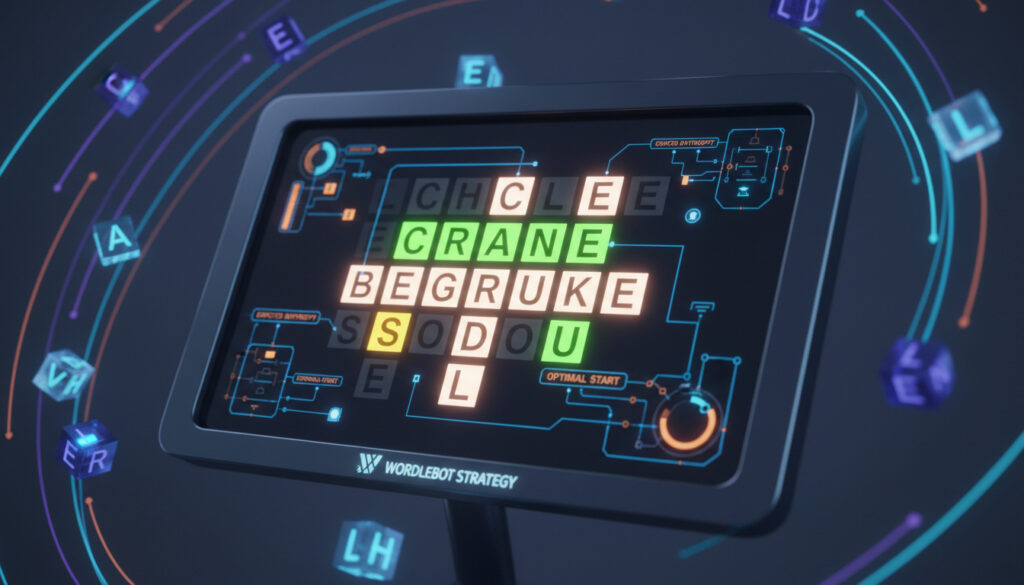
Best Wordle Starting Word – Top WordleBot Picks
Selecting the optimal first guess in Wordle determines how quickly players reach the daily solution. Data from the New York Times WordleBot identifies specific five-letter combinations that maximize information gain through strategic letter placement.
Openers containing high-frequency letters such as E, A, R, S, T, L, and N consistently outperform random selections. Analysis of solver statistics reveals that words like SLATE, CRANE, and TRACE share a 99 out of 100 skill rating, indicating superior efficiency in narrowing possible solutions.
What Is the Best Starting Word for Wordle?
WordleBot calculates skill ratings based on information theory and letter frequency across a 4,500-word sample. The tool prioritizes starters that eliminate the most alternatives in a single guess.
| Starter | WordleBot Score | Key Letters | Past Answer? |
|---|---|---|---|
| CRANE | 99/100 | C, R, A, N, E | Yes |
| SLATE | 99/100 | S, L, A, T, E | Yes |
| TRACE | 99/100 | T, R, A, C, E | Yes |
| CARTE | 99/100 | C, A, R, T, E | No |
These selections outperform 98-rated alternatives such as SLANT, PLATE, and STARE by leveraging common positional frequencies for consonants and vowels.
- Prioritize letters appearing in over 5% of English five-letter words (E, A, R, S, T)
- Maintain balance with two vowels and three distinct consonants
- Avoid repeating letters to maximize information coverage
- Consider common blends like ST, SL, and CR for positional advantage
- Cross-reference with WordleBot’s updated solver data monthly
| Fact | Detail |
|---|---|
| Game Type | Daily 5-letter word puzzle |
| Launch | 2021 by Josh Wardle |
| Current Owner | NYT Games (acquired 2022) |
| Analysis Tool | WordleBot evaluates solver efficiency |
| Primary Metric | Average guesses to solution |
| Letter Frequency | E leads with 422 occurrences; A and Y follow |
Why Is CRANE the Top Recommended Wordle Starter?
CRANE dominates rankings due to its combination of high-frequency vowels (A, E) and consonants (C, R, N). The arrangement tests critical letters that appear in both initial and final positions across the solution set.
How Letter Frequency Shapes Strategy
The opener targets R and E, which appear in approximately 20% of five-letter solutions. By placing N in the fourth position, CRANE verifies a common ending consonant while maintaining flexibility for words like BRAIN, GRAIN, or PRONE.
What Makes an Opener Effective?
Effective starters partition the solution space through high entropy. Entropy measures how evenly a guess splits remaining possibilities. Words scoring 99/100 typically reduce candidate pools by 85% or more on the first attempt.
Following CRANE with SOUTH tests ten high-frequency letters including S, O, U, T, and H. Independent analysis from developer resources confirms this combination covers the majority of common English phonemes.
CRANE vs SLATE vs TRACE: Which Wordle Opener Wins?
Each 99-rated starter offers distinct advantages based on letter positioning and player preference. While statistical differences remain marginal, specific strategies favor particular openers.
Performance Under Simulation
SLATE emphasizes initial blends (SL, ST) and terminal E, fitting words like SLIME or STATE. TRACE swaps the starting letter to T, proving equally effective with averages between 3.58 and 3.625 guesses. CRANE maintains similar efficiency at 3.610 to 3.635 guesses according to entropy calculations.
Choosing between these options resembles evaluating TSA Banned Costco Cards – Facts, Myths and Rules: the details matter more than the surface similarity. Players prioritizing S-initial words prefer SLATE, while those avoiding past answers might select CARTE.
When to Select TRACE
TRACE excels when solutions likely contain T-leading words such as TRAIL or TREAT. Data from regional gaming analysis places TRACE at 3.58 average guesses in asymmetric simulations, marginally outperforming CRANE in specific datasets.
WordleBot and Data Behind the Best Starters
The New York Times WordleBot updates recommendations based on aggregate solver data. Unlike static frequency tables, the tool adapts to how actual players solve puzzles, weighting skill over pure luck.
Mathematical Models vs. Practical Play
Grant Sanderson’s 3Blue1Brown analysis initially favored CRANE but later identified SOARE as optimal for the specific answer list. Mathematicians meanwhile rank SALET highest at 3.421 average guesses. Andrew Steele’s entropy calculations position REAST at 3.604, TRACE at 3.608, and CRANE at 3.610, demonstrating minimal variance among top contenders.
Source 3Blue1Brown video analysis prioritizes answer-list specificity, while Andrew Steele’s entropy model maximizes information gain against all possible solutions. These methodologies explain ranking differences.
Hard Mode Considerations
Hard mode requires players to reuse confirmed letters in subsequent guesses. This constraint alters optimal strategy, favoring words with flexible letter positioning. WordleBot scores CLASP, SCALD, and PLACE at 99/99 for hard mode, as they allow multiple branching paths once letters confirm.
SLATE, CRANE, and TRACE have appeared as previous solutions. Players concerned about overlap should consider CARTE (99/100, never used) or SLANT (98/100), supported by official WordleBot data.
How Has the Best Wordle Starting Word Changed Over Time?
- : Wordle launches publicly with simple frequency-based strategies.
- : Viral adoption prompts NYT Games acquisition and development of algorithmic analysis.
- : WordleBot launches, introducing data-driven starter recommendations.
- : CRANE overtakes earlier favorites in WordleBot rankings based on solver efficiency data.
- : TRACE briefly tops recommendations before alternating patterns emerge.
- to : WordleBot alternates between recommending SLATE and CRANE as updates process new solver statistics.
Is There a Perfect Wordle Starting Word?
| Established Facts | Remaining Uncertainties |
|---|---|
| CRANE, SLATE, and TRACE achieve 99/100 WordleBot skill scores | Daily word distribution variance affects real-world performance |
| Hard mode requires different starters (CLASP 99/99) | Luck factor accounts for 30-50% of solve efficiency |
| High-entropy words reduce average guesses below 3.65 | Long-term answer list exclusions remain unconfirmed |
| E and A appear in over 40% of solution positions | Community preference variations (ADIEU vs. SLATE) lack statistical backing |
What Makes a Good Wordle Opener?
Effective openers balance vowel frequency with consonant diversity. The English language distributes E, A, and R heavily across five-letter words, making them essential for early confirmation. Strategically, players should aim for high-entropy selections that split the remaining solution space evenly, regardless of feedback color.
Approaching letter selection requires similar precision to planning outdoor activities at outdoor activity destinations.
More related posts
 How Much I Pet In urance? Average Co t in Ireland
 Galaxy M20 to Buy – Prices Deals Availability 2024
 After the Hunt Reviews: Critics’ Opinions and Plot Explained
 K-12 Education News Today: AI Policies, Issues & Rankings
 What Is Atorvastatin Used For – Dosage, Side Effects and More
 Windows 11 Release Date: Upgrade Deadline & What’s Next
 Subsidized vs Unsubsidized Loans: Which Is Better? [2025]
 AT&T Stock: Buy, Sell, or Hold? Analysis & Forecast 2025