Is Black a Color – Science, Art and Perception Explained
The question of whether black qualifies as a color sparks debate across scientific, artistic, and everyday contexts. Physics defines color through visible light wavelengths, yet black dominates art supplies and fashion palettes worldwide. This apparent contradiction reveals how different fields approach the same concept from entirely different angles. Understanding why requires examining how light, pigments, and human perception each contribute to what we call “color.”
For centuries, philosophers and scientists have grappled with where darkness fits in our visual vocabulary. Aristotle treated black as a fundamental opposite to white, while Isaac Newton’s 17th-century prism experiments reframed the entire debate around light and wavelengths. Today, the answer depends entirely on which framework you apply—and each framework holds valid internal logic.
This exploration cuts through the confusion by examining the scientific basis for color, how artists actually use black, and why the answer varies so dramatically across disciplines. The distinction matters not just for academics but for anyone working with light, design, or visual media.
Is Black a Color? A Multi-Framework Overview
The answer fundamentally shifts depending on which definition of “color” you apply. No single framework dominates across all contexts, making this one of the more nuanced questions in visual science.
No – absence of light
Yes – a pigment shade
(0, 0, 0)
High ink coverage
Key Insights
- Black absorbs nearly all visible wavelengths rather than reflecting specific colors back to the eye
- Human retinas contain three cone types (red, green, blue); black provides no stimulation to any cone
- No true black pigment exists—commercially available black inks mix multiple dark hues
- Black materials heat faster in sunlight because absorbed light converts entirely to thermal energy
- Aristotle’s color philosophy dominated Western thought for approximately 2,000 years before Newton’s reframing
- Modern color models (RGB, CMYK) both treat black as an endpoint rather than a hue
- Perceptual models include black alongside pink as non-spectral but recognizable colors
| Perspective | Black as Absence | Black as Color/Shade |
|---|---|---|
| Physics/Spectrum | Yes: No wavelengths reflected | No: Not in ROYGBIV |
| Art/Pigments | Partial: Mixed for effect | Yes: Used like hues |
| Perception | Yes: No cone stimulation | Yes: Recognized visually |
| Digital Models | Yes (zero light) | Yes (achromatic extreme) |
What Does Science Say About Black?
Physics measures color through the visible light spectrum, which spans roughly 400 to 700 nanometers from violet to red. When light strikes an object, what we perceive as color depends entirely on which wavelengths that object reflects back to our eyes. Black objects absorb nearly all incoming wavelengths, reflecting negligible light back to the retina.
Light Absorption and the Retina
The human visual system relies on photoreceptor cells called cones to detect color. These cones come in three varieties, each sensitive to overlapping ranges of red, green, or blue wavelengths. When light enters the eye, cones send signals to the brain that translate into color perception. Black provides no stimulation whatsoever—no photons trigger any cone response, resulting in what scientists describe as visual absence rather than a color signal.
This explains why staring at bright lights followed by darkness feels different from looking at a black surface. Afterimages occur because cone cells adapt and temporarily misfire, but a true black field offers no reference point for comparison. According to Britannica’s analysis of color science, this neurochemical reality forms the foundation of why physics traditionally excludes black from the color category.
The visible spectrum excludes ultraviolet (below 400nm) and infrared (above 700nm)—wavelengths humans cannot detect without specialized equipment. Black operates in a similar position: detectable effects (heating, light absorption) exist, but the visual system registers nothing. This parallel reinforces why scientists place black outside the spectral color definition.
Where Does Black Fit in the Color Spectrum?
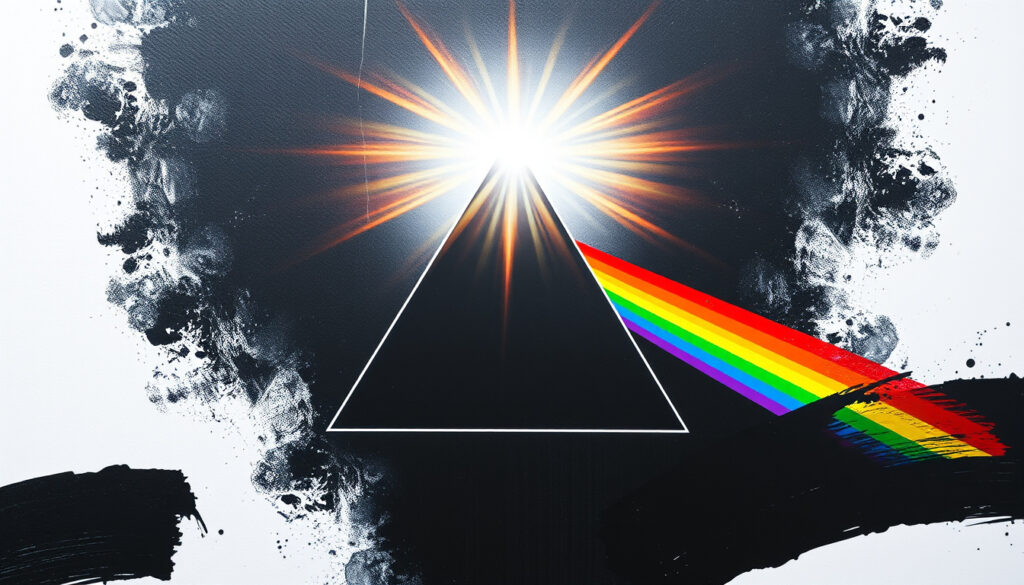
Traditional rainbow spectra display colors produced when white light refracts through water droplets or prisms. This phenomenon, which Newton documented in 1666, creates the familiar ROYGBIV arrangement (red, orange, yellow, green, blue, indigo, violet). Black appears nowhere in this sequence—it cannot be produced through wavelength separation because it represents the opposite condition: zero wavelengths transmitted or reflected.
However, scientific consensus has evolved since Newton’s initial classification. Modern color science acknowledges that perceptual models must account for phenomena outside the pure spectral range. Pink offers a useful comparison—it’s also non-spectral, created through simultaneous stimulation of red and blue cones with minimal green involvement, yet nobody questions whether pink qualifies as a color. By similar reasoning, researchers studying light and color models have extended color classification beyond strict spectral definitions.
Visible light wavelengths create distinct color perceptions: red (620-700nm), green (495-570nm), blue (450-495nm). Objects appear colored when they selectively reflect or transmit specific ranges. Black surfaces absorb across the entire spectrum, preventing any wavelength-specific response in the retina.
Is Black a Shade or a Color in Art?
Artists operate in a entirely different framework than physicists. Where scientists measure light wavelengths, painters work with pigments—substances that absorb specific light frequencies while reflecting others. This subtractive color system treats black as a legitimate, practical color with distinct properties and mixing behaviors.
Mixing Pigments to Create Black
No commercially available black pigment consists of a single pure substance. Instead, black paints typically combine multiple dark pigments—ultramarine blue, burnt sienna, phthalocyanine green—that together absorb most visible wavelengths. This composite nature explains why different black pigments (ivory black, lamp black, vine black) produce subtly different visual effects despite appearing identical to casual observers.
The physics classroom resources on light and color explain that each pigment absorbs complementary wavelengths. Mixing cyan and red pigments creates black because cyan removes red wavelengths while the red pigment removes cyan—together, they eliminate nearly all reflected light. This process mirrors the CMYK printing model used in professional graphics, where overlapping cyan, magenta, and yellow inks approximate black through subtractive mixing.
Artistic Usage and Visual Contrast
Beyond mixing, artists employ black strategically for its visual properties. Black creates depth perception through contrast with lighter values, defines edges without color contamination, and establishes focal points within compositions. Renaissance masters used transparent black glazes over other colors to create shadow depth impossible to achieve through direct pigment mixing alone.
This practical approach extends to design disciplines where black serves functions no spectral color can replicate. Packaging designers use black to convey premium quality; architects specify black fixtures for dramatic lighting effects; photographers exploit black backgrounds to isolate subjects. In each application, practitioners treat black as a full member of the color palette, regardless of what physics textbooks might claim.
Artists should note that “mixing to black” and “mixing to darkness” describe different phenomena. Pigment mixing approaches black through complementary subtraction, while light mixing achieves black through zero emission. A canvas painted with black gesso looks different under lighting than a monitor displaying RGB (0,0,0) black—the former reflects minimal light while the latter emits none.
How Does Black Compare to White?
White and black occupy opposite positions in nearly every color model, yet both resist simple classification. White contains all visible wavelengths in approximately equal intensity—sunlight filtered through atmospheric particles produces the broadband white we experience as daylight. Black absorbs all wavelengths. Together, they form the endpoints of the lightness dimension in perceptual color spaces like Munsell and LAB.
This duality creates interesting asymmetries. White light splits into rainbow colors through refraction; black light reveals nothing to split. Adding pigments to white progressively darkens it toward gray and eventually black. Removing light from a scene progressively darkens it toward black. Both paths converge on the same perceptual endpoint despite fundamentally different mechanisms.
Interestingly, some cultures historically classified white and black as the only true colors, with all others occupying intermediate positions. This view persists in certain philosophical frameworks that treat hue as the defining color characteristic. Under such definitions, both white and black fall outside the color category—though they remain essential components of visual experience.
A Brief History of Black in Color Theory
Western understanding of color evolved significantly over two millennia. Ancient Greek philosophers, particularly Aristotle, established black and white as fundamental opposites representing earth and fire elements. This binary framework dominated European thought, positioning other colors as combinations or variations of these two primaries.
Isaac Newton’s 1666 prism experiments fundamentally restructured color science. By demonstrating that white light contains all spectral hues, Newton established the wavelength-based framework still used today. His work on spectrum definition explicitly excluded black as a spectral hue, instead treating it as the absence condition required to perceive color contrasts.
- Ancient Greece (pre-300 BCE): Aristotle establishes black-white as fundamental opposites tied to elemental philosophy.
- 1666: Newton uses prisms to isolate spectral colors, defining black as absence rather than hue.
- 19th Century: Additive color models (RGB) formalize the relationship between light mixing and darkness.
- 20th Century: Digital color representation (CMYK, monitor RGB) standardizes black as a computational endpoint.
- Present: Inclusive color models acknowledge non-spectral colors like black and pink within practical frameworks.
What We Know—and What Remains Unclear
The debate over black’s color status benefits from clear documentation of what different fields have established versus where genuine uncertainty persists.
| Established Information | Unresolved Questions |
|---|---|
| Physics: Black absorbs nearly all visible light wavelengths | Whether formal definitions should expand to include perceptual colors alongside spectral ones |
| Retinas: No cone stimulation occurs when viewing black | How cultural associations with black affect perceptual categorization |
| Pigments: No pure black pigment exists; all contain multiple colorants | Whether the absence of visual signal constitutes a distinct color experience |
| Models: Both RGB and CMYK treat black as an endpoint extreme | How evolutionary biology shaped human color categorization schemes |
Research on color categorization across cultures suggests that linguistic frameworks influence perceptual grouping. Some languages distinguish fewer color terms than English, potentially affecting how black gets classified. The neuroscience of “seeing darkness” versus “seeing nothing” remains an active research area with implications for vision science and philosophy of perception.
The Broader Context: Color Theory Models
Understanding black requires familiarity with the two dominant color models used across science and industry. These frameworks approach black from opposite directions while arriving at consistent endpoints.
The additive color model (RGB) describes how light combines. Digital screens emit colored light that adds together—red plus green plus blue at full intensity produces white. Conversely, zero intensity across all channels produces black. This model applies directly to monitors, smartphones, and other light-emitting displays, where black pixels simply power down local light sources.
The subtractive color model (CMYK) describes pigment behavior. Cyan, magenta, and yellow inks each absorb specific wavelength ranges. Overlapping all three absorbs nearly all visible light, creating near-black. Professional printing adds a dedicated black (K) channel because achieving true black through mixed inks requires impractical ink volumes and produces color variations.
Both models treat black as an extreme boundary condition rather than a color among colors. The distinction matters practically: photographers distinguish “blacks” from “colors” when editing; designers separate value from hue in color pickers; printer calibration produces separate profiles for dark and colored output. These conventions reflect the shared intuition that black occupies a special position in visual systems.
Sources and Expert Perspectives
The scientific literature on color classification spans physics, neuroscience, philosophy, and art theory. Major academic sources approach the question from distinct disciplinary angles, producing sometimes-conflicting but internally consistent conclusions.
“Color is not a physical property of objects or of light. Rather, color is a sensation produced in the brain. Different wavelengths of light produce different color sensations, but the two should not be confused.”
— Physics Classroom analysis of light and color perception
“Black is an ‘achromatic’ colour, which means that it does not have a hue. You will not find black in the visible spectrum of light — it is not one of the colours that a prism creates. However, black is still a colour in the sense that it is the combination of all the other colours together.”
— Adrian Reynolds, Colour Theory Analysis
These perspectives illustrate how the same phenomenon—black surface illumination—generates entirely different interpretive frameworks. The physicist focuses on wavelength absorption; the color theorist focuses on perceptual results. Neither perspective invalidates the other; instead, they address different layers of the same complex reality.
Summary: Does Black Count as a Color?
The definitive answer depends entirely on which definition you apply. Under strict physics definitions tied to the visible spectrum, black qualifies as the absence of color—no wavelengths reflected means no color signal transmitted to the brain. Under artistic and perceptual frameworks that include non-spectral colors, black functions as a legitimate, useful member of the color family alongside pink and other mixture-based hues.
Both perspectives hold validity within their domains. Scientists investigating light-absorption phenomena use spectral definitions that exclude black by design. Artists mixing pigments and designers selecting palettes treat black as a practical color with unique properties no spectral hue can replicate. The debate persists because different communities prioritize different aspects of the color concept.
For most everyday purposes—whether selecting white chocolate packaging or comparing Black Friday deals on electronics—treating black as a color works perfectly well. The context determines which framework serves best.
Frequently Asked Questions
Is black part of the color spectrum?
No, black does not appear in the visible light spectrum produced by prisms or rainbows. The spectrum (ROYGBIV) contains only colors with specific wavelengths; black represents zero wavelengths reflected, which cannot be separated or displayed as a spectral band.
What colors make black when mixed?
In pigment mixing, cyan plus magenta plus yellow creates near-black through subtractive absorption. In digital RGB, zero intensity across all channels produces black. No single pigment or light frequency creates true black—multiple colorants or channels combine to absorb or eliminate all visible wavelengths.
Is black a primary color?
Black is not considered a primary color in either major color system. RGB uses red, green, and blue primaries; CMYK uses cyan, magenta, and yellow primaries. Black functions as a key or knockout channel in printing and as an endpoint in digital displays, but it is always derived from other colorants.
Does black absorb more heat than lighter colors?
Yes, black surfaces absorb nearly all incident light, converting that energy to thermal heat. Lighter surfaces reflect more energy, staying cooler. This differential heating effect underlies practical applications from building design to vehicle paint selection.
Is white considered a color alongside black?
White faces the same classification ambiguity as black. Under strict spectral definitions, white contains all wavelengths and thus qualifies as a color. Under subtractive definitions, white represents the absence of pigment. Like black, white classification depends entirely on which framework applies.
Why do artists use black if it’s not technically a color?
Artists use black because it functions as a color in practical application—it creates visual contrast, defines shadows, and mixes darker values. The physics classification doesn’t affect how pigments behave or how viewers perceive dark areas, so artists apply black-based techniques regardless of theoretical debates.
Can you have true black in printed materials?
Professional printing comes closest using solid black (K) ink on coated stock, but even this represents absorbed light rather than zero reflectance. Printed “black” typically shows under magnification as dense but imperfect pigment coverage, with reflectance values measurable but negligible.
More related posts
 23 Signs You Grew Up with Ehlers-Danlos Syndrome – Childhood Symptoms Guide
 Samford vs Texas A&M: 48-0 Recap, Highlights and Key Takeaways
 Best Queso Humacha Near Me: Types, Taste, and Guide
 Metro PCS Near Me: Stores, Hours & Services Guide
 IND vs ENG Test Series 2025: Schedule, Results, Head-to-Head
 Bing AI Image Generator: Free Tutorial & Step-by-Step Guide
 What Is a Nepo Baby? Definition, Richest, and Controversy
 Siding Companies Near Me – Detroit’s Top Contractors