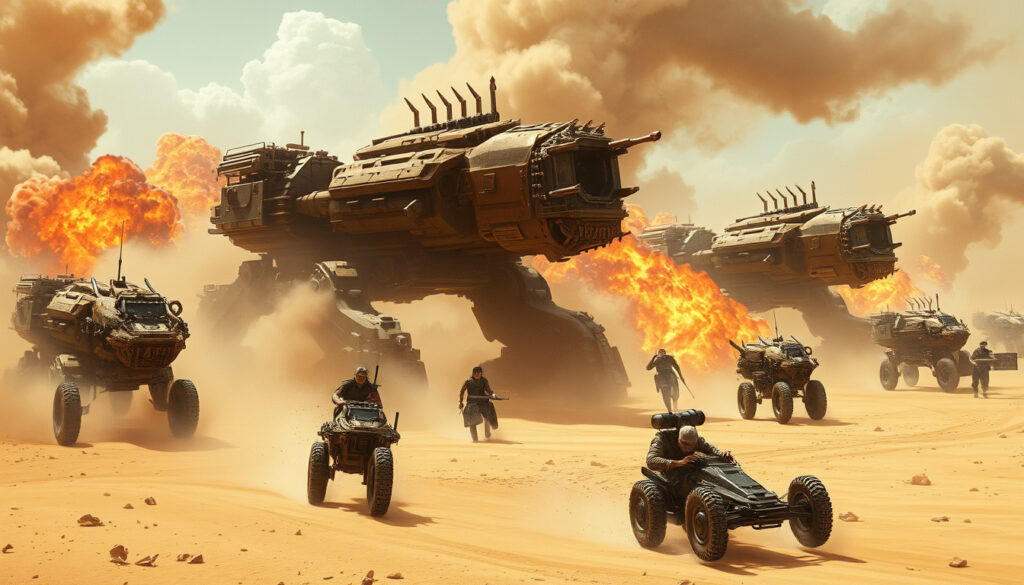
Mad Max: Fury Road: Feuds, Lore & Iconic Fame
Mad Max: Fury Road turned 10 recently, and people still argue about whether it’s the greatest action film ever made. The film’s staying power comes from what happened behind the camera as much as what audiences saw on screen — Tom Hardy and Charlize Theron brought Furiosa and Max to life during a production that nearly broke under the weight of its own ambition.
Director: George Miller · Stars: Tom Hardy, Charlize Theron · Release Year: 2015 · Runtime: 120 minutes · Rotten Tomatoes: 97% critics score
Quick snapshot
- 97% on Rotten Tomatoes (Rotten Tomatoes)
- 6 Oscar wins for technical categories (Rotten Tomatoes)
- Tom Hardy and Charlize Theron had a documented feud during production (NZ Herald)
- Exact private conversations that sparked the on-set confrontation
- Whether Hardy and Theron have fully reconciled since
- Long-term box office projections for potential sequels
- Fury Road released in 2015
- Furiosa prequel released in 2024
- The feud made headlines during production, with oral history published by NZ Herald
- Furiosa prequel established a new chapter in the franchise
- Future sequels remain unconfirmed beyond the prequel
- Hardy reflected on lessons learned during the original production
Mad Max: Fury Road earned critical acclaim and commercial success across several key data points.
| Label | Value |
|---|---|
| Director | George Miller |
| Lead Actors | Tom Hardy, Charlize Theron |
| Genre | Action, Science Fiction |
| Box Office | $380 million worldwide |
| Streaming | Available on Netflix |
Why is Mad Max: Fury Road so famous?
Mad Max: Fury Road earned a 97% critics score on Rotten Tomatoes, a rare feat that places it among the most acclaimed films of its decade. The film won six Academy Awards — all in technical categories like Best Production Design, Best Cinematography, and Best Film Editing. These weren’t handed out for spectacle alone; the practical stunt work, custom vehicle designs, and desert cinematography required years of preparation under brutal conditions in Namibia.
Director George Miller spent months designing and building the vehicles from scratch, creating what became known as the “War Rig” — a converted weapon of war transformed into a nurturing body for the film’s symbolic narrative. The practical approach meant real explosions, real crashes, and real risks for the stunt team. Audiences noticed the difference immediately.
The film’s critical dominance wasn’t accidental. Miller’s decision to film real stunts in extreme desert heat created both a production nightmare and an authenticity that CGI could never replicate. That trade-off is exactly what made Fury Road stand apart from every other franchise action film of its era.
The cultural impact extended beyond awards. Furiosa — played by Charlize Theron — became an instant icon despite the franchise originally centering on Max. Her leadership role in the film broke from franchise tradition, with Theron’s character barking orders to Max throughout the chase sequence. The dynamic between Theron’s Furiosa and Hardy’s Max elevated both characters into mythology almost immediately.
Why did Tom Hardy not get along with Charlize Theron?
The on-set tension between Tom Hardy and Charlize Theron became one of Hollywood’s most publicized behind-the-scenes conflicts. According to reporting by El País, the confrontation reached a breaking point when Charlize Theron arrived on set at 8 a.m. as scheduled, waited in the War Rig for hours, and Tom Hardy arrived late despite a special request to be on time.
When Hardy finally arrived, Theron confronted him directly. She reportedly demanded a $100,000 fine per minute Hardy held up the crew — a threat that captured just how volatile the situation had become. Camera operator Mark Goellnicht documented the explosive confrontation, and producer Denise di Novi was subsequently assigned to be with Theron at all times to prevent further conflicts.
George Miller later stated there was “no excuse” for the obvious feud between Hardy and Theron. Both actors later took responsibility, citing grueling production schedules and a lack of mutual trust as the main triggers. The grueling Namibia desert conditions — where the film was shot — only amplified every stress point.
In Blood, Sweat & Chrome: The Wild and True Story of Mad Max (published in 2022), Theron described the dynamic as “like two parents in the front of the car.” Hardy offered his own reflection: “What she needed was a better, perhaps more experienced partner in me. That’s something that can’t be faked.” He added that in hindsight, he felt “in over my head in many ways” and acknowledged the “overwhelming” pressure on both performers during production.
Director George Miller described Hardy and Theron as “two very different performers,” noting that Hardy “has a damage to him but also a brilliance that comes with it.” Hardy had to be coaxed out of his trailer during production — a detail that illustrates the magnitude of what Miller was managing alongside the physical demands of the shoot.
The lesson wasn’t lost on Miller. When preparing the Furiosa prequel, he spoke personally with the lead actors before shooting to prevent another feud, telling them: “You have to be obsessive about safety — physical safety, as the shoot goes on and fatigue sets in, but also psychological safety.” Whether Hardy and Theron have fully reconciled since remains unclear, but the professional acknowledgment from both sides suggests a measured peace.
Is Mad Max: Fury Road connected to Mad Max?
Mad Max: Fury Road functions as a loose sequel to the original Mad Max trilogy while standing as a soft reboot of the franchise. Max Rockatansky (Tom Hardy) returns as the titular character, maintaining continuity with the post-apocalyptic world established in earlier films. However, the story was designed to be accessible to newcomers, with enough context provided on screen that viewers unfamiliar with the earlier films could follow the narrative.
The shared universe spans multiple films: Mad Max (1979), Mad Max 2 (1981), Mad Max Beyond Thunderdome (1985), Mad Max: Fury Road (2015), and Furiosa: A Mad Max Saga (2024). Fury Road is a prequel to the prequel in a sense — Furiosa’s backstory gets filled in by the 2024 film, while the original trilogy established the Wasteland rules and Max’s role within it.
The franchise’s greatest strength is also its most deliberate restraint: Max has no extensive origin story, no flashback sequences explaining his past. He simply exists in the Wasteland, and the audience accepts him. Fury Road respects that tradition while centering the narrative on Furiosa instead.
Character continuity runs through the Citadel — the fortress ruled by Immortan Joe in Fury Road — which appears in both films and represents the power structure Max and Furiosa ultimately disrupt. The design language, vehicle aesthetics, and world-building rules carry across both films, creating a coherent universe despite the decades between production dates.
The implication: Fury Road bridges decades of franchise history while refusing to over-explain its protagonist, a balance that rewards both longtime fans and newcomers.
Why is Furiosa not a breeder?
In the film’s world, “breeders” are women kept by Immortan Joe at the Citadel specifically for reproduction purposes — a role Furiosa was born into but escaped. According to lore established in the film and expanded through supplementary materials, Furiosa was taken from her “green place” as a child and raised within Immortan Joe’s compound. Her infertility — revealed during the film when she tells the group she cannot have children — is a detail that shapes her rebellion motivation.
Furiosa’s journey is fundamentally about escaping a role she was assigned at birth. She was not a breeder by choice or biology — she was a “wife” of Immortan Joe, one of five women kept for breeding purposes within the Citadel. Her post-apocalyptic mission to escape with the other “wives” drives the entire narrative of Fury Road.
Furiosa’s infertility isn’t played as weakness — it’s played as liberation. She is not trapped by the possibility of pregnancy during the escape. Her agency comes from refusing the role entirely, and the film frames this as strength, not loss. The 2024 Furiosa prequel expands on her backstory and the green place she remembers, though it remains unclear exactly how much of the original film’s lore the prequel directly confirms versus interprets.
The term “breeder” itself carries specific weight in the film’s hierarchy: Immortan Joe controls reproduction at the Citadel, and the “mothers” kept there produce milk as a traded resource — a detail tied directly to the mother’s milk symbolism explored in the next section.
What is mother’s milk in Furiosa?
Mother’s milk in Mad Max: Fury Road functions as both a literal resource and a symbolic device. At the Citadel, breast milk is “farmed” from mothers — women coerced into producing milk, often those with dead babies — to be traded as an alternative to water. This is not a minor plot detail; it’s central to Immortan Joe’s control over the Wasteland.
During the film, Max washes blood from his face using breast milk from the War Rig’s pumps. According to analysis from I Wanted Wings, this moment is a deliberate inversion: the milk is extracted from coerced mothers and weaponized as a survival tool, yet Max uses it for purification after his first proactively selfless act. The ritual position makes the milk an instrument of redemption.
The film’s feminist symbolism doesn’t sanitize the horror of the milk’s source — it’s still extracted through exploitation. But the narrative uses that same substance for Max’s redemption arc, forcing the audience to hold both meanings simultaneously: survival under patriarchal control, and individual transformation that transcends that control.
The War Rig itself was secretly converted from a weapon of war to a nurturing body — a tanker carrying water and mother’s milk across the desert. This physical transformation mirrors the symbolic one: the vehicle built for violence becomes the means of salvation. In the film’s world, the milk represents everything Immortan Joe hoards: water, food, and human reproduction itself, all funneled through his control.
What this means: The milk scene crystallizes Fury Road’s feminist argument — patriarchal systems extract from women’s bodies, but those same resources become tools of liberation when redirected by women who refuse their assigned roles.
In hindsight, I was in over my head in many ways. The pressure on both of us was overwhelming at times.
— Tom Hardy, in Blood, Sweat & Chrome: The Wild and True Story of Mad Max (2022)
What she needed was a better, perhaps more experienced partner in me. That’s something that can’t be faked. I’d like to think that now that I’m older and uglier, I could rise to that occasion.
— Tom Hardy, reflecting on the Fury Road production
Related reading: Tom Hardy and Charlize Theron feud
Behind the Hardy-Theron feud and Furiosa’s Citadel lore lies the film’s gripping plot cast cars guide that fueled its 97% Rotten Tomatoes acclaim and iconic status.
Frequently asked questions
Who directed Mad Max: Fury Road?
George Miller directed Mad Max: Fury Road. Miller created the original Mad Max franchise in 1979 and returned to direct the 2015 installment after decades of development.
What is the runtime of Mad Max: Fury Road?
Mad Max: Fury Road has a runtime of 120 minutes (2 hours). The film is known for its continuous chase sequences that comprise most of the narrative.
Where was Mad Max: Fury Road filmed?
Mad Max: Fury Road was filmed primarily in Namibia, specifically in the Namib Desert. The brutal desert conditions created both production challenges and the authentic Wasteland visuals audiences saw on screen.
What awards did Mad Max: Fury Road win?
Mad Max: Fury Road won six Academy Awards, all in technical categories: Best Production Design, Best Cinematography, Best Film Editing, Best Costume Design, Best Sound Editing, and Best Sound Mixing.
Is Mad Max: Fury Road family friendly?
Mad Max: Fury Road is not family friendly. The film carries an R rating for strong violence, language, and thematic content. It is designed for adult audiences.
What cars are in Mad Max: Fury Road?
Mad Max: Fury Road features hundreds of custom-built vehicles, including the iconic War Rig (a massive tanker truck), the Interceptor (Max’s pursuit vehicle), and various War Boys vehicles. Most vehicles were built from scratch by the production team.
How long is the Mad Max: Fury Road chase?
The primary chase sequence in Mad Max: Fury Road runs for most of the film’s 120-minute runtime. The action is essentially continuous, with brief pauses between set-piece stunts rather than traditional scene breaks.
More related posts
 Best Wordle Starting Word – Top WordleBot Picks
 Feliz Día del Padre: Wishes, Dates, and Traditions Guide
 Kevin Hart Net Worth 2025: $450 Million, Not a Billionaire
 Car Key Replacement Near Me: Cost, DIY & Cheapest Options
 Siding Companies Near Me – Detroit’s Top Contractors
 Golden Corral Near Me – Locations, Prices, Menus & Hours
 Attack on Pearl Harbor: Why Japan Attacked and What Happened
 Best Deviled Egg Recipe: 5 Golden Rules & Secret Ingredients