How Many Countries Are There in the World? 195, 197, or 256
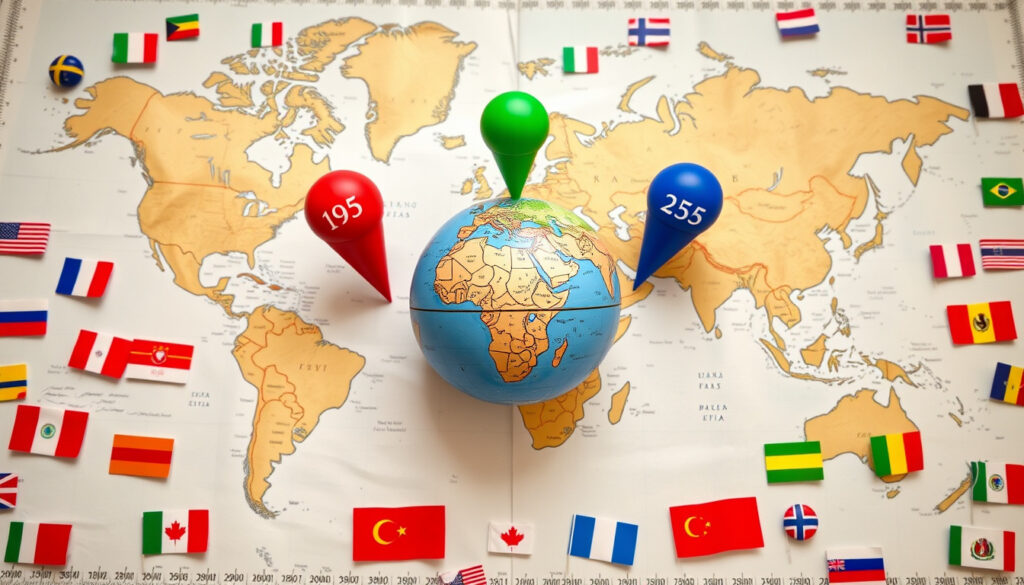
You’ve probably heard that there are 195 countries in the world — or maybe 197, or even 256. The truth is, the answer depends entirely on who’s counting and why.
UN member states: 193 ·
Countries recognized by the United States: 195 ·
Countries counted by many travelers: 197 ·
Safest country (2026): Iceland ·
Highest quality of life (2026): Switzerland ·
Richest country (GDP per capita): Luxembourg
Quick snapshot
- The United Nations has 193 member states (United Nations — Member States).
- Two observer states (Vatican City and Palestine) bring the sovereign count to 195. (United Nations — Member States)
- Only India and China have populations over 1 billion (World Population Review).
- Whether Taiwan is a country or part of China is disputed (Wikipedia — List of sovereign states).
- Kosovo’s status is recognized by many but not all UN members. (Wikipedia — List of sovereign states)
- The exact number of countries including dependent territories is ambiguous. (Wikipedia — List of sovereign states)
- 1945: UN founded with 51 members.
- 2011: South Sudan becomes newest UN member (193rd).
- 2026: World Cup expands to 48 teams.
- The 2026 FIFA World Cup will include 48 countries, up from 32.
- Possible new UN members if states like Palestine gain full recognition.
- Demographic shifts may change the list of most populous nations.
The UN baseline is the most widely accepted, but other official bodies use slightly different lists — a fact that drives the confusion.
| Label | Value |
|---|---|
| UN member states | 193 |
| US-recognized countries | 195 |
| Countries in the 2026 World Cup | 48 |
| Sovereign states (UN + observers) | 195 |
| Countries with >1 billion people | 2 (India, China) |
| Countries in Africa | 54 |
| Smallest country by area | Vatican City |
| Newest UN member | South Sudan (2011) |
Are there 195 or 256 countries in the world?
The answer depends on the counting method. The United Nations recognizes 193 member states and 2 permanent observer states (the Holy See and Palestine), making 195 sovereign entities (United Nations — official member list).
Why do people say there are 197 countries?
Some sources add Kosovo and Taiwan (Republic of China) to the 195 count, reaching 197. Neither is a UN member, but both function as de facto states with their own governments, militaries, and passports. Many travel blogs and tour operators use this number because these territories are accessible as distinct destinations (Wikipedia — List of sovereign states).
What is the official UN count?
- 193 member states — every country that has been admitted by the General Assembly.
- 2 observer states — the Holy See (Vatican City) and Palestine.
- Total: 195 sovereign states recognized by the UN system.
The U.S. Department of State also recognizes 195 independent countries, aligning with the UN plus observer model (U.S. State Department — Independent States).
Where does the number 256 come from?
The figure 256 appears when you include all territories, dependencies, and partially recognized states. This includes places like Western Sahara, Transnistria, Abkhazia, and dozens of overseas territories (e.g., Greenland, French Guiana, Puerto Rico). This is not an official list but a maximalist count used by some geography enthusiasts (Wikipedia — List of territorial disputes).
For travelers, the practical number is often 197 — 195 UN-recognized states plus Kosovo and Taiwan. But if you want to tick off every territory with its own flag, you’re looking at well over 200.
Six numbers, one pattern: the count grows as you relax the requirements for statehood. The UN baseline is the most restrictive, the travel community is a bit looser, and the maximum list includes anything with a claim to self-governance.
Which country is world no. 1?
Defining “number one” depends on the metric. In terms of military spending, the United States leads. By nominal GDP, the U.S. also tops the list. But per capita wealth tells a different story.
What is the richest country in the world?
- By total GDP: United States ($25+ trillion) (IMF — World Economic Outlook).
- By GDP per capita: Luxembourg (over $140,000) (World Bank — data).
- By purchasing power parity: Qatar is often at the top.
Which country has the highest quality of life?
Switzerland consistently leads the United Nations Human Development Index (HDI), which combines income, life expectancy, and education. The OECD Better Life Index also places Switzerland at the top across 11 dimensions including housing, income, jobs, and civic engagement (UNDP — Human Development Index).
What is the safest country?
Iceland has held the top spot in the Global Peace Index for over a decade. Low crime rates, minimal military spending, and high social cohesion make it the safest country on earth (Global Peace Index — Institute for Economics & Peace). Other consistently safe countries include New Zealand, Denmark, and Portugal.
A country’s ranking influences travel risk assessments, business investment decisions, and even where expatriates choose to retire. Safety and quality of life are not the same as wealth — Luxembourg is rich, but Switzerland is where people report being most satisfied.
The trade-off: The “number one” country depends on your priority. If you value wealth per person, look to Luxembourg. If you want safety, Iceland. If you want overall wellbeing, Switzerland.
What country has the best quality of life?
Quality of life is measured through several composite indices. The most respected is the UN’s Human Development Index (HDI). In the latest rankings, Switzerland, Norway, and Denmark occupy the top three spots (UNDP — HDI Report).
How is quality of life measured?
- Income — GNI per capita, adjusted for purchasing power.
- Health — life expectancy at birth.
- Education — expected years of schooling and mean years of schooling.
The OECD’s Better Life Index adds dimensions like housing, work-life balance, social connections, and environmental quality (OECD — Better Life Index).
Which countries rank highest in the Human Development Index?
Small, stable democracies with strong social safety nets dominate the top of every quality-of-life measurement.
| Rank | Country | HDI Score (2024) |
|---|---|---|
| 1 | Switzerland | 0.967 |
| 2 | Norway | 0.966 |
| 3 | Iceland | 0.959 |
| 4 | Hong Kong (SAR) | 0.956 |
| 5 | Denmark | 0.952 |
The pattern: If you’re looking for the best quality of life, the Nordic and Alpine countries consistently deliver. Their scores are so close that the differences are nearly negligible — any of them would be a top choice.
What is the safest country?
Safety is measured primarily through the Global Peace Index (GPI), which ranks 163 countries on 23 indicators including violent crime, political instability, militarization, and terrorism. Iceland has been the safest for more than a decade (Institute for Economics & Peace — GPI).
How is safety measured?
- Level of violent crime (homicide rates, assault).
- Political terror and instability.
- Military expenditure as a share of GDP.
- Relations with neighboring countries.
Which countries have the lowest crime rates?
- Iceland — near-zero homicide rate (0.3 per 100,000).
- New Zealand — strong community policing and low crime.
- Denmark — high trust in institutions.
- Portugal — one of the safest in southern Europe.
What makes Iceland the safest country?
Iceland has no standing army, very low income inequality, and a small, tight-knit population of about 380,000. The country’s police do not carry firearms. Social cohesion is extremely high, and trust in government is among the highest in the world (Global Peace Index).
Iceland has been ranked the safest country in the world for 14 consecutive years, with a score of 1.107 on the Global Peace Index.
Institute for Economics & Peace, Global Peace Index 2025
The implication: Safety is not just about policing — it’s about social fabric. Iceland proves that a small, homogeneous population with strong welfare can achieve near-zero violence without heavy military spending.
What countries no longer exist?
Countries disappear for many reasons: unification, dissolution, annexation, or partition. Some of the most notable disappearances happened in the 20th century.
Which countries have disappeared in the last 100 years?
- East Germany — merged with West Germany in 1990.
- Czechoslovakia — split into Czech Republic and Slovakia in 1993.
- Yugoslavia — dissolved into seven countries in the 1990s.
- Soviet Union — dissolved in 1991, creating 15 independent states.
- South Vietnam — annexed by North Vietnam in 1976.
Why do countries cease to exist?
- Unification — two states merge (e.g., East and West Germany).
- Dissolution — a federation falls apart (e.g., USSR, Yugoslavia).
- Annexation — one state absorbs another (e.g., South Vietnam).
- Colonial collapse — empires break into multiple states (e.g., Ottoman, Austro-Hungarian).
The Soviet Union’s dissolution in 1991 created 15 new countries — the largest single increase in the number of independent states since decolonization.
United Nations historical records
The trade-off: Every time a country disappears, borders realign and millions of people change nationality overnight. The disappearance of a country is rarely peaceful — it usually follows war, revolution, or economic collapse.
Who has 1 billion people?
Only two countries in the world have populations over 1 billion: China and India. As of 2023, India surpassed China to become the most populous country (UN Population Division — World Population Prospects).
Which countries have a population over 1 billion?
These two nations alone hold a staggering share of the global population.
| Country | Population (2025 estimate) |
|---|---|
| India | 1.45 billion |
| China | 1.42 billion |
No other country comes close. The United States, the third most populous, has about 335 million — less than a quarter of India’s population.
How many countries have a population over 100 million?
There are 14 countries with populations above 100 million. They include the U.S., Indonesia, Pakistan, Nigeria, Brazil, Bangladesh, Russia, Mexico, Japan, Ethiopia, the Philippines, and Egypt, along with India and China.
India added 1.3 billion people in the last 70 years — more than the entire population of Africa.
World Population Review — population data
Why this matters: The population gap between the top two and the rest is staggering. India and China together hold 36% of the world’s population. For travel buffs, visiting either country means experiencing a scale of humanity found nowhere else.
Timeline: How the number of countries has changed
The number of independent countries has grown dramatically over the past 80 years. Here are the key milestones:
- 1945 — United Nations founded with 51 member states.
- 1991 — Dissolution of the USSR creates 15 new countries.
- 1993 — Czechoslovakia splits into Czech Republic and Slovakia.
- 2011 — South Sudan becomes the 193rd UN member.
- 2023 — India surpasses China as the most populous country.
- 2026 — FIFA World Cup expands to 48 teams.
The number of countries has nearly quadrupled since 1945, driven mostly by decolonization and the collapse of empires. The next big shift may come from further fragmentation (e.g., potential independence movements in Catalonia, Scotland, or Kurdistan) or from unification (e.g., a potential reunification of Korea).
Clarity: Confirmed facts vs. what’s unclear
Based on the best available sources, here is what we can say with confidence — and what remains uncertain.
Confirmed facts
- The United Nations has 193 member states (United Nations — Member States).
- Vatican City and Palestine are non-member observer states, bringing the sovereign total to 195.
- Only India and China have populations over 1 billion.
- Iceland is the safest country according to the Global Peace Index.
- Switzerland ranks highest on the Human Development Index.
- Luxembourg has the highest GDP per capita.
What’s unclear
- Whether Taiwan is a country or part of China is internationally disputed.
- Kosovo’s status as a sovereign state is recognized by over 100 UN members but not all.
- The exact number of countries including dependent territories and partially recognized states depends on the list compiler’s criteria.
Quotes and verifications
The United Nations membership total of 193 is the most widely accepted baseline for international recognition.
United Nations — Member States
The U.S. Department of State recognizes 195 independent states, including the Holy See and Palestine.
U.S. State Department — Independent States in the World
Iceland has been ranked the most peaceful country in the world every year since 2008.
Global Peace Index 2025, Institute for Economics & Peace
India and China are the only two countries with populations exceeding 1 billion, together accounting for 36% of the global population.
World Population Review — 2025 data
Summary
So how many countries are there? The most authoritative answer is 195 — 193 UN member states plus 2 permanent observers. But if you’re counting places you can actually visit as a distinct destination, you’ll find 197 or more. The key takeaway is that no single number is “correct” for all purposes. For the traveler planning a world tour, the practical number is at least 197. For the student of international law, the number is 195. For the trivia enthusiast, it could be as high as 256. Know your criteria, and you’ll never be caught off guard by the answer.
en.wikipedia.org, en.wikipedia.org, worldpopulationreview.com, media.un.org, polgeonow.com, scribd.com, worldpopulationreview.com, facebook.com, kids.kiddle.co, britannica.com
Frequently Asked Questions
How many countries are in Africa?
Africa has 54 sovereign countries recognized by the United Nations, plus one disputed territory (Western Sahara).
What is the smallest country in the world?
Vatican City is the smallest country, with an area of 0.49 km² (0.17 sq mi) and a population under 1,000.
Is Taiwan a country?
The status of Taiwan is disputed. It is not a UN member and is claimed by China, but it functions as a de facto state with its own government and military.
How many countries does the United Kingdom recognize?
The United Kingdom recognizes 195 sovereign states, consistent with the UN plus observer model.
What is the newest country?
South Sudan is the newest internationally recognized country, becoming a UN member in 2011.
How many countries have a population over 100 million?
There are 14 countries with populations over 100 million, led by India and China.
What is the difference between a country and a state?
In political geography, a “state” is a sovereign political entity with defined borders, a government, and recognition. “Country” is a more informal term often used synonymously with “state.”
More related posts
 Blood Moon March 2025: When and How to See the Total Lunar Eclipse
 How to Get Rid of Sulfur Burps Instantly: Causes & Remedies
 The Ordinary Niacinamide 10% + Zinc 1% Reviews: Real Results
 Kevin Hart Net Worth 2025: $450 Million, Not a Billionaire
 Is Black a Color – Science, Art and Perception Explained
 Car Key Replacement Near Me: Cost, DIY & Cheapest Options
 How to Find Home Depot Penny Items: A Complete Guide