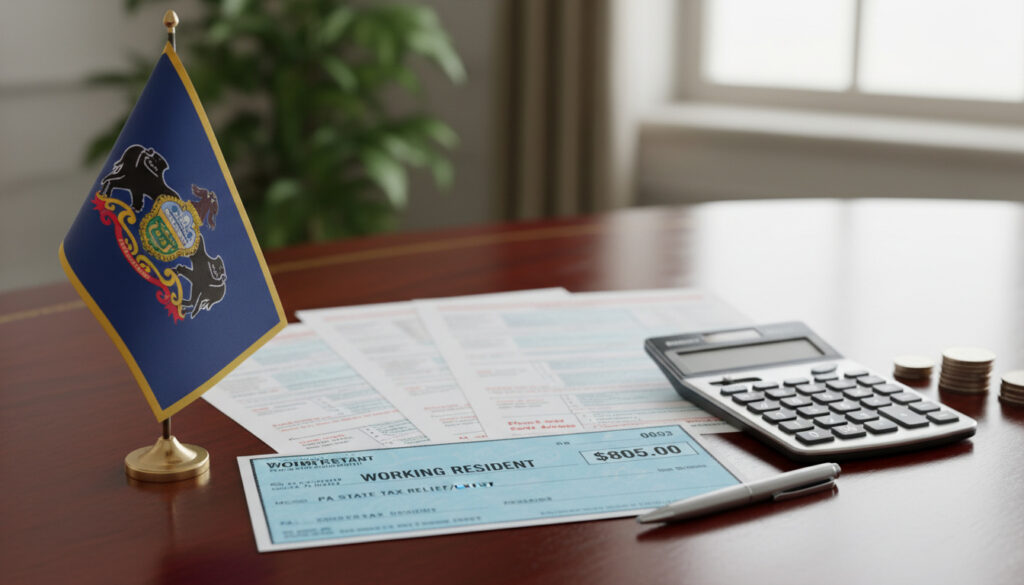
Working Pennsylvanians Tax Credit Details – How to Claim Up to $805
Pennsylvania workers earning moderate incomes can claim a new state tax credit starting with their 2025 tax returns. The Working Pennsylvanians Tax Credit (WPTC) offers refundable relief equal to ten percent of the federal Earned Income Tax Credit, with maximum benefits reaching $805 for qualifying families.
Enacted in November 2025 as part of Governor Josh Shapiro’s $50.1 billion budget, the program automatically extends to approximately one million residents who already qualify for federal EITC benefits. The Pennsylvania Department of Revenue administers the WPTC through the standard PA-40 personal income tax return, requiring no separate enrollment process for eligible households.
The credit represents the first new tax benefit specifically targeting low-income workers in Pennsylvania in over five decades, delivering an estimated $193.5 million in total relief.
What is the Working Pennsylvanians Tax Credit?
Eligibility Foundation
Automatic qualification for anyone receiving the federal Earned Income Tax Credit with Pennsylvania earned income.
Maximum Benefit
$805 for the 2025 tax year, calculated as exactly ten percent of the federal EITC maximum.
Claim Method
Filed automatically via the PA-40 state return; no supplemental application required.
Program Status
Enacted November 2025; first claims processed on returns filed in early 2026.
Key Program Characteristics
- Matching Structure: The credit mirrors ten percent of the federal EITC amount dollar-for-dollar.
- Refundable Design: Recipients receive the full credit even if state tax liability is zero.
- Scale: Between 940,000 and one million Pennsylvanians qualify for relief.
- Budget Impact: $193 million to $193.5 million allocated for beneficiary payments.
- Historical Context: First new state tax benefit for low-income workers in more than 50 years.
- Integration: Seamlessly connects to existing federal tax infrastructure.
- Investment Cap: Claimants must have investment income below $11,950.
| Attribute | Specification |
|---|---|
| Credit Calculation | 10% of federal EITC |
| Maximum Amount (2025) | $805 |
| Tax Year | 2025 (filed 2026) |
| Funding Source | $50.1 billion state budget appropriation |
| Projected Beneficiaries | 940,000 – 1,000,000 |
| Administrative Agency | PA Department of Revenue |
| Credit Type | Fully refundable |
| Residency Requirement | Full-year Pennsylvania resident |
Who qualifies for the Working Pennsylvanians Tax Credit?
Federal EITC Alignment
Qualification mirrors federal EITC rules exactly. If you claim the federal credit on Form 1040, you automatically qualify for the state equivalent. Key criteria include earned income sourced in Pennsylvania, valid Social Security number, and U.S. citizenship or legal resident status for the entire tax year.
If you receive the federal Earned Income Tax Credit, you automatically qualify for the WPTC. The state credit uses identical eligibility criteria, including income thresholds and dependent qualifications established by federal guidelines.
Income Thresholds
Adjusted gross income limits vary by filing status and dependent count. For single, head of household, widowed, or married filing separately statuses, the ceilings range from $19,104 (no dependents) to $61,555 (three or more dependents). Married couples filing jointly face higher thresholds, maxing at $68,675 for families with three or more children.
Special Populations
Workers without qualifying children face additional constraints: ages 25 through 65, residence in the United States for more than half the year, and status as non-dependents on another return. Investment income cannot exceed $11,950 for any claimant category.
How much is the Working Pennsylvanians Tax Credit worth?
Calculation Method
The credit equals precisely ten percent of the federal EITC amount. Federal maximums for 2025 range from $649 (no children) to $8,046 (three or more children), yielding state credits between $65 and $805.
Real-World Scenarios
A single parent with three children earning $23,300 receives the maximum $805 credit. The same filer with two children at $50,000 income receives approximately $154. Married couples with two children at $30,470 income qualify for roughly $715, while a three-child married couple at $60,000 receives about $183.
Higher earnings reduce the credit amount proportionally. A single parent with two children earning $50,000 receives significantly less than the maximum, while moderate-income families near federal thresholds see smaller state benefits.
| Dependents | Max Federal EITC | Max WPTC | Estimated Beneficiaries |
|---|---|---|---|
| 0 | $649 | $65 | 261,739 |
| 1 | $4,328 | $433 | 314,291 |
| 2 | $7,152 | $715 | 230,575 |
The official WPTC calculator on revenue.pa.gov provides personalized estimates based on filing status, income, and dependent status, though results remain informational until formal filing.
How do I apply for the Working Pennsylvanians Tax Credit?
Filing Requirements
No separate application exists. Claimants must file federal Form 1040 and claim the federal EITC, then file the PA-40 state return. The Department of Revenue automatically calculates and applies the WPTC, reducing taxes owed or issuing refunds even when no tax liability exists.
The Department of Revenue requires access to your federal Form 1040 to process the WPTC. Ensure you retain this documentation when filing electronically or maintain copies for paper submissions.
Electronic Filing Advantages
E-filing both returns simultaneously through commercial tax software provides the most efficient processing. The automatic calculation feature reduces mathematical errors and accelerates refund timelines compared to paper submissions.
When can Pennsylvanians first claim the credit?
- November 2025: Governor Shapiro signs the $50.1 billion budget enacting the WPTC program for the 2025-26 fiscal year.
- January 1, 2026: Tax year 2025 concludes; eligible workers finalize annual earnings calculations.
- January 27, 2026: Pennsylvania tax filing season opens, accepting PA-40 returns with WPTC claims.
- April 15, 2026: Standard deadline for filing Pennsylvania personal income tax returns claiming the credit for tax year 2025.
Federal filing extensions may apply to the WPTC, though specific state extension rules remain undefined beyond standard personal income tax procedures.
What program details remain certain versus unclear?
| Established Information | Pending or Unclear Details |
|---|---|
| 10% calculation formula of federal EITC | Specific processing timelines for refund issuance |
| $805 maximum credit for 2025 | Interaction effects with other state tax forgiveness programs |
| Income thresholds by filing status and dependents | Whether future legislative changes will adjust percentage rates |
| Automatic claiming via PA-40 return | Long-term funding commitments beyond initial budget cycle |
| April 15, 2026 filing deadline | Specific administrative procedures for amended returns |
Why did Pennsylvania establish this tax credit?
The WPTC addresses decades of stagnation in state-level support for working families. Governor Shapiro’s administration positioned the measure as a response to persistent financial pressures facing low and moderate-income households, particularly regarding housing affordability and daily expenses. Unlike the separate Property Tax Rent Rebate Program—which targets seniors and disabled residents regardless of employment status—the WPTC specifically rewards workforce participation.
The program’s structure mirrors successful federal EITC expansion efforts while avoiding complex new bureaucratic infrastructure. By piggybacking on existing Internal Revenue Service determinations, Pennsylvania minimized administrative overhead while maximizing outreach to eligible populations. For workers managing Personal Loan Interest Rates and other financial obligations, the refundable nature provides immediate liquidity rather than merely reducing tax liability.
What have officials said about the program?
“This is about delivering real relief for working families who are the backbone of our economy. For the first time in over 50 years, Pennsylvania is offering a new tax benefit specifically designed to help low-income workers keep more of what they earn.”
Governor Josh Shapiro
Administration officials emphasize that the credit targets families earning too much for traditional welfare programs but insufficient to absorb rising costs. Revenue department representatives confirm that eligibility audits will align with federal EITC verification processes to prevent improper payments.
Summary
The Working Pennsylvanians Tax Credit provides up to $805 in refundable state tax relief for 2025, automatically available to the approximately one million Pennsylvania workers who qualify for federal EITC benefits. By filing standard federal and state tax returns in early 2026, eligible residents claim the ten percent match without separate applications or enrollment deadlines. Those receiving refunds might consider depositing funds into a High Interest Savings Account US to maximize the benefit’s long-term impact.
Frequently Asked Questions
Is the WPTC the same as Pennsylvania’s Property Tax Rent Rebate?
No. The Property Tax Rent Rebate Program serves seniors and disabled residents regardless of employment. The WPTC specifically targets working Pennsylvanians through the income tax system based on federal EITC qualifications.
Can I claim this credit if I have no dependent children?
Yes, provided you meet federal EITC criteria for childless workers: ages 25 through 65, not claimed as a dependent, and residing in the U.S. more than half the year. The maximum credit for this group is $65.
What if I file for a federal tax extension?
Extensions available for federal EITC claims may apply to the WPTC, though specific state extension procedures remain undefined. File by the standard April 15, 2026 deadline to guarantee processing.
Does WPTC count as income for other benefit programs?
The research does not specify interactions with means-tested programs. Consult eligibility counselors for programs such as SNAP or Medicaid regarding tax credit treatment.
Can part-time workers qualify?
Yes, if you have earned income meeting federal EITC thresholds and satisfy residency requirements. Hours worked matter less than total annual earnings and filing status compliance.
What if I moved to Pennsylvania mid-year?
You must be a legal U.S. resident for the full year and a Pennsylvania resident to qualify. Partial-year residency disqualifies the claim for tax year 2025.
More related posts
 Head Over Heels Kdrama: Episodes, Ending, Cast & Season 2
 Taco Bell 2000s Y2K Menu – Revived Items and History Guide
 Texas A&M – Rankings, Facts and Traditions 2025
 Traductor English to Spanish: Best Free Tools & How to Use Them
 Both Sides Now Lyrics – Meaning, History & Covers
 Yeh Rishta Kya Kehlata Hai – Generations, Cast and Latest Updates
 Galaxy M20 to Buy – Prices Deals Availability 2024
 Cast of Murder in a Small Town: Full Season 1, 2 & 3 Guide