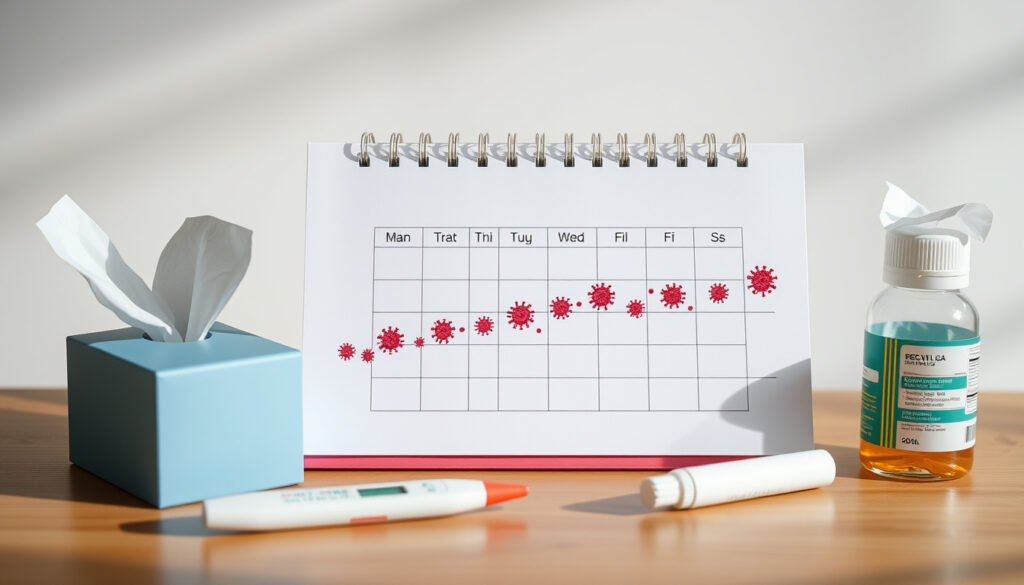
How Long Are You Contagious With the Flu? A Day-by-Day Timeline
You wake up with a fever, a cough, and that familiar ache—and the first question that pops into your head is probably not “What strain is this?” but “How long until I’m not a danger to everyone around me?” The answer matters for your roommates, your coworkers, and your own peace of mind. The truth is, you can be contagious a full day before you feel sick, and the peak window for spreading the virus is the first three days of illness. We’ll walk through the day-by-day timeline of flu contagiousness, backed by CDC guidelines, so you know exactly when you can safely rejoin the world.
Average contagious period: 5–7 days from symptom onset ·
Peak contagiousness: First 3 days of illness ·
Contagious before symptoms: 1 day before symptoms appear
Quick snapshot
- Contagious from 1 day before symptoms to 5–7 days after (CDC – How Flu Spreads)
- Most contagious in first 3 days (CDC – How Flu Spreads)
- Fever resolution key marker for end of contagiousness (CDC – Respiratory Virus Guidance)
- Exact duration varies by age, immunity
- Impact of Tamiflu on contagious window (limited evidence)
- Whether flu B differs from flu A
- Day 0: exposure – incubation begins
- Day 1–2: may be contagious before symptoms
- Day 2–5: peak contagiousness
- Day 5–7: recovery, lower risk
- Isolate at least 5 days from symptom onset
- Return to normal after 24 hours fever-free
- Take added precautions for 5 more days
Key facts at a glance
Five critical numbers that define the flu’s contagious window, drawn from CDC (public health authority) and Colorado Department of Public Health and Environment (state health agency).
| Fact | Value |
|---|---|
| Contagious before symptoms | 1 day before |
| Peak contagiousness | First 3 days of illness |
| Average contagious duration | 5–7 days |
| Recommended isolation | At least 5 days after symptom onset |
| When to stop isolating | 24 hours fever-free without fever reducers |
The pattern: the contagious window is longer than you might guess—starting before you feel sick and lasting well past the worst symptoms. The fever-free milestone is the single most reliable exit signal.
How long are you contagious with the flu? A day-by-day timeline
How long are you contagious with the flu before symptoms?
- You can be contagious about 1 day before symptoms appear, according to CDC (U.S. public health agency).
- This means you might be spreading the virus before you even know you’re sick.
- Infectiousness is greatest within 3 to 4 days after illness onset, per the CDC Yellow Book (travel health reference).
The implication: if you’ve been exposed, don’t wait for symptoms to take precautions. The pre-symptomatic day is a hidden window of transmission.
How long are you contagious with flu after taking Tamiflu?
- The CDC notes that antiviral medications may reduce the duration of illness, but the impact on contagiousness is not well established.
- Limited evidence suggests that Tamiflu might shorten the contagious window, but the standard recommendation still applies: isolate until fever-free for 24 hours.
The catch: no hard data yet confirms a shorter contagious period with Tamiflu. Rely on fever resolution, not the prescription, to decide when it’s safe to be around others.
How long after exposure to flu are you contagious?
- The incubation period (time from exposure to symptoms) is typically 1–4 days, average 2 days, per CDC – How Flu Spreads.
- You become contagious about 1 day before symptoms, so the contagious period starts roughly 1–3 days after exposure.
What this means: if you were around someone with flu on Monday, you could be contagious by Tuesday or Wednesday—even before you feel anything.
How long are you contagious with flu B?
- The CDC’s guidance applies to both influenza A and B: the contagious window is similar, starting 1 day before symptoms and lasting 5–7 days.
- Colorado Department of Public Health and Environment (state health agency) does not differentiate between strains in its infectious period guidance.
The trade-off: while flu B tends to be milder in some seasons, the contagious timeline is the same. Don’t let milder symptoms trick you into ending isolation early.
Most adults don’t realize they’re contagious before symptoms hit. That pre-symptomatic day is why the flu spreads so efficiently in households and offices. The worst day of the flu is typically day 2–3, and that’s also when you’re most contagious.
When is a flu no longer contagious?
How do I know when my flu is no longer contagious?
- The CDC’s respiratory virus guidance (public health protocol) says you can return to normal activities when your symptoms are getting better overall AND you have not had a fever for at least 24 hours without using fever-reducing medication.
- Even after that, you should take added precautions for the next 5 days—like wearing a mask and keeping distance—because you may still be contagious.
The pattern: the fever-free rule is your green light, but it’s not an instant switch. The virus can linger at low levels, so the 5-day precaution period is a safety net.
You can still spread the virus even after symptoms improve and fever has been gone for 24 hours, warns the CDC (federal health authority). That’s why the added precautions for the next 5 days are not optional—they protect vulnerable people around you.
What are the 5 stages of flu?
- Incubation (Day 0–2): virus enters body, no symptoms yet. Contagiousness begins about 1 day before symptoms.
- Onset (Day 2–3): fever, cough, body aches. Most contagious period begins.
- Peak (Day 3–5): symptoms at worst. High fever, severe fatigue. Still highly contagious.
- Recovery (Day 5–7): symptoms improve. Contagiousness declines but can still spread.
- Lingering symptoms (Day 7+): cough or fatigue may persist. Most are no longer contagious.
What’s the worst day of the flu?
- Most people report the worst symptoms on day 2 or 3 after symptoms begin, according to CDC (public health agency).
- This also coincides with the peak of contagiousness.
The implication: the day you feel the worst is also the day you’re most likely to infect others. Stay home, rest, and avoid contact.
How long should I stay away from someone who had the flu?
Can I go out after 5 days of flu?
- The CDC recommends staying home for at least 5 days after symptom onset, and isolating until you have been fever-free for 24 hours without medication.
- If fever persists beyond 5 days, continue isolation until the fever-free criterion is met.
- After returning to normal activities, take added precautions for the next 5 days (mask, distance, hygiene).
The trade-off: five days is a minimum, not a guarantee. If you still have a fever on day 5, you’re still contagious. The fever-free rule overrides the calendar.
How to flush the flu out fast
Home treatment steps for flu
- Rest: your body needs energy to fight the virus.
- Hydrate: water, clear broths, electrolyte drinks prevent dehydration from fever.
- Over-the-counter relief: acetaminophen or ibuprofen for fever and body aches. (See our guide on ibuprofen dosing for safe use.)
- Antiviral medication: if prescribed within 48 hours of symptoms, it can shorten illness duration. The CDC (health authority) recommends antivirals for high-risk groups.
- When to seek medical attention: difficulty breathing, persistent chest pain, confusion, severe dehydration, or fever that returns after improving.
The upshot: there’s no magic flush, but early rest and hydration cut recovery time. The key is to start supportive care the moment symptoms appear.
The most effective way to “flush the flu out fast” is to slow down. People who push through symptoms often end up sick longer and spread the virus more. Your best weapon is isolation.
Flu contagiousness timeline: day by day
Six stages from exposure to recovery, based on CDC (infectious disease authority) and Colorado Department of Public Health and Environment (state health agency).
| Period | What happens | Contagious? |
|---|---|---|
| Day 0 (exposure) | Virus enters body; incubation begins. | No |
| Day 1–2 (incubation) | No symptoms yet; may be contagious 1 day before symptoms. | Yes (1 day before) |
| Day 2–3 (onset) | Symptoms appear; fever, cough, body aches. | Highly contagious |
| Day 3–5 (peak) | Symptoms at worst; high fever, severe fatigue. | Highly contagious |
| Day 5–7 (recovery) | Symptoms improve; contagiousness declines. | Can still spread |
| Day 7+ | Most no longer contagious; return to normal if fever-free. | Usually not |
The pattern: the contagious window is longer than the symptomatic window. You can spread flu before you feel sick and after you feel better—the fever-free rule is the only reliable exit.
What we know and what remains unclear
Confirmed facts
- Contagious from 1 day before symptoms to 5–7 days after (CDC – How Flu Spreads)
- Most contagious in first 3 days (CDC – How Flu Spreads)
- Fever resolution is key marker for end of contagiousness (CDC – Respiratory Virus Guidance)
What’s unclear
- Exact duration of contagiousness for individuals (varies by age, immunity)
- Impact of Tamiflu on contagiousness duration (limited evidence)
- Whether flu B has a different contagious window than flu A
Expert perspectives on flu contagiousness
People with flu are most contagious during the first 3 days of their illness.
CDC – How Flu Spreads (public health authority)
Most adults with influenza are infectious from the day before symptom onset to approximately 5 to 7 days after symptom onset.
CDC Yellow Book – Influenza (travel health reference)
The infectious period is 1 day before symptom onset through 5 to 7 days after symptom onset. People with flu are most contagious in the first 3 to 4 days after symptom onset.
Colorado Department of Public Health and Environment (state health agency)
The takeaway: three authoritative sources converge on the same window—1 day before, 5–7 days after, with peak in the first 3–4 days. The consistency across federal and state health agencies gives confidence in these numbers.
Summary: what this means for you
The flu’s contagious window is longer than most people assume—starting before you feel sick and lasting well past the worst symptoms. For anyone with flu symptoms, the choice is clear: isolate at the first sign, stay home for at least 5 days, and only rejoin the world after 24 hours fever-free without medication. For the next 5 days after that, wear a mask and keep distance. Your coworkers, family, and community—especially those who are immunocompromised or very young—depend on that extra caution. The alternative? Spreading the virus to someone who might not bounce back as quickly.
cdc.gov, prevention.com, cdc.gov, cbsnews.com, doctorguideonline.com, droracle.ai, webmd.com, cdc.gov, sante.gouv.fr, today.com
Frequently asked questions
Can you get the flu from a flu shot?
No. The flu vaccine contains inactivated virus or a single gene from a flu virus, which cannot cause the flu. Some people experience mild side effects like soreness or low-grade fever, which are not the flu.
Does the flu vaccine protect against all strains?
The vaccine is formulated to protect against the three or four strains most likely to circulate each season. It does not cover all strains, but it reduces severity and complications even if you get infected.
How long does flu immunity last after infection?
Immunity after a flu infection can last for months to years, but because flu viruses mutate, you can still get sick from a different strain in the same season.
Can you spread the flu if you have no symptoms?
Yes. The CDC says you can be contagious 1 day before symptoms appear, and some people, especially children, may be contagious without ever showing symptoms.
When should you see a doctor for flu?
Seek medical attention if you have difficulty breathing, persistent chest pain, confusion, severe dehydration, or if fever returns after improving. High-risk groups (pregnant, elderly, chronic conditions) should contact their doctor early.
How long does the flu virus live on surfaces?
Influenza viruses can survive on hard surfaces for 24 to 48 hours, but they are easily killed with soap and water or disinfectant. The main route of spread is through respiratory droplets, not surfaces.
More related posts
 Samford vs Texas A&M: 48-0 Recap, Highlights and Key Takeaways
 Six Flags Magic Mountain: X2 and Scariest Rides Guide
 ICE Arrests Maine Police Officer: Evans, Wamba & More
 48 Laws of Power: Complete List, Summary & Controversy
 YouTube TV Sign In – Step-by-Step Guide for All Devices
 1000 Free Games to Play: Best Platforms & Tips for 2026
 Hoka Clifton 9 Women’s Review: Expert Insights and Facts
 Batman: The Animated Series: Season 2, HBO, R-Rated