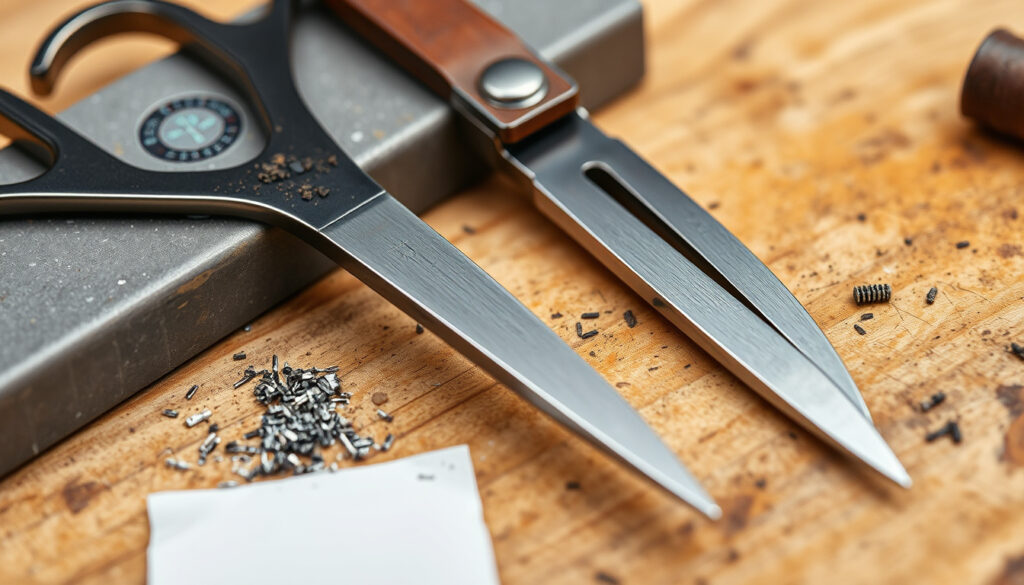
How to Sharpen Scissors at Home: 5 Methods That Work
Anyone who’s tried to cut through paper with dull scissors knows the frustration. The blades skip, tear, and demand extra force. The good news: you can restore that smooth cut at home with items you already own — and a few of them actually work.
Most searched household method: Aluminum foil ·
Recommended method by experts: Sharpening stone ·
Cost of professional sharpening: $5–$10
Quick snapshot
- Aluminum foil method works for minor dullness (The Spruce (home improvement guide))
- Sharpening stone can restore sharp edge (The Spruce)
- Coin method’s long-term effect on edge quality
- Vinegar and baking soda effectiveness
- Testing scissors by cutting paper is a standard way to check sharpness (Work Sharp (tool manufacturer))
- Consider a handheld scissor sharpener for easy maintenance (Blade Magazine (knife industry publication))
| Fact | Details |
|---|---|
| Signs of dull scissors | Tearing instead of cutting, skipping, requiring force (Work Sharp) |
| Common myth | Cutting aluminum foil will severely damage blades (false) (The Spruce) |
| Best method for long-term results | Sharpening stone (The Spruce) |
How do I sharpen my scissors at home?
You have several options, from quick household hacks to proper stone sharpening. Which one works best depends on how dull your scissors are and what you’re comfortable doing.
What household items can I use?
- Aluminum foil: fold it several times and cut through it repeatedly. The foil acts as a mild abrasive that hones the edge. (The Spruce)
- Sandpaper: cut through a sheet of fine-grit sandpaper (200-400 grit). The abrasive particles polish the edge. (The Spruce)
- Ceramic mug: use the unglazed bottom rim as a substitute sharpening stone. (Work Sharp)
The implication: household items can handle light dullness, but they won’t restore a truly blunt edge.
How to sharpen scissors without a stone?
If you don’t have a stone, try a coin or a screwdriver shaft. Hold the coin at the same angle as the bevel and run it along the edge several times. The Spruce notes that these methods are less precise and best for quick touch-ups. The catch: you risk uneven sharpening if you don’t maintain a consistent angle.
Is it safe to sharpen scissors at home?
Yes, with basic precautions. Always handle blades carefully, keep fingers away from the cutting edge, and work over a towel to avoid slips. The Spruce recommends disassembling the scissors when using a stone to sharpen each blade individually.
Household methods are fast and free, but they only work on lightly dull scissors. For scissors that have been neglected for years, only a stone or professional sharpening will bring back the factory edge.
Does cutting aluminum foil sharpen your scissors?
This is the most viral scissor hack online. But does it actually sharpen, or just polish? Let’s look at the science.
How does the aluminum foil method work?
When you cut through folded foil, the aluminum creates micro-abrasion on the blade edge. The Spruce explains that this can hone a lightly dull edge, but it won’t remove enough metal to reshape a damaged bevel. It’s more of a maintenance trick than a true sharpening method.
How many times should you cut foil?
Most guides recommend 10–20 cuts through folded foil. Work Sharp cautions that overdoing it can leave micro-scratches on the blade.
Is aluminum foil a temporary fix?
Yes. The effect wears off after a few uses. The Spruce describes it as a quick fix that should not replace regular sharpening with a stone or professional service.
Aluminum foil does not sharpen scissors in the technical sense — it smooths the edge temporarily. For scissors that won’t cut paper cleanly, this method will disappoint.
How to sharpen scissors at home without a sharpener?
Sometimes you need a solution right now, and the only tool at hand is a coin or a glass jar. Here’s what works and what doesn’t.
Can I use a coin to sharpen scissors?
Yes, but it’s a crude method. Hold the edge of the coin against the blade at the same angle as the bevel and slide it along. The Spruce lists this as a common DIY hack, but warns it’s easy to round the edge if you’re not careful. The long-term effect on edge quality is unknown.
Does sandpaper work for sharpening scissors?
Cutting through sandpaper (200–400 grit) is more effective than foil because the abrasive is harder. The Spruce confirms it can restore a moderately dull edge. However, the grit wears down quickly, and you need to use a fresh sheet for each session.
How do I sharpen scissors with a glass jar?
Turn a glass jar upside down and run the blade edge along the unglazed bottom rim. Work Sharp mentions this as a substitute for a ceramic stone, but the narrow surface makes it hard to maintain a consistent angle for the entire blade length.
The pattern: without a dedicated sharpener, you’re trading precision for convenience. The results vary widely.
Does toothpaste sharpen scissors?
Toothpaste as a sharpening agent is another popular internet tip. Here’s how it stacks up.
How does toothpaste sharpen scissors?
Toothpaste contains mild abrasives (silica, calcium carbonate) that can polish a blade edge. The Spruce notes that it’s often combined with a cloth or paper to increase friction. However, the abrasive is too fine to remove significant metal — it’s best for lightly dull blades.
Should I use regular or whitening toothpaste?
Whitening toothpaste contains stronger abrasives, but Work Sharp suggests that any toothpaste with at least a mild abrasive will work. Avoid gel formulas, which lack the grit.
Is toothpaste combined with other methods?
Yes. Some users apply toothpaste to a piece of sandpaper or a cloth and then cut through it repeatedly. The Spruce describes this as a multi-step approach that can improve results, but still not as effective as a stone.
Toothpaste sharpening is a last-resort hack. If you have a stone, use it. If you don’t, toothpaste can buy you a few more weeks of clean cuts.
What is the easiest way to sharpen scissors at home?
Ease and effectiveness are often at odds. Here’s a direct comparison of the three most popular approaches.
The table below shows how the methods stack up.
| Method | Effectiveness | Risk of damage | Skill required |
|---|---|---|---|
| Aluminum foil | Low (temporary hone) | Low | None |
| Sharpening stone | High (restores edge) | Medium (if angle wrong) | Moderate |
| Handheld sharpener | Medium–High | Low | Low |
Blade Magazine recommends handheld sharpeners for users who want minimal hassle. The Spruce agrees that a stone yields the best results but requires patience.
What is the fastest method?
Aluminum foil takes under a minute. The Spruce notes that it’s the quickest way to improve a slightly dull blade, but the effect is short-lived.
What method requires the least skill?
Cutting foil or sandpaper requires no technique. A handheld sharpener is also straightforward — you simply insert the blade and pull. Blade Magazine calls these the easiest route.
Which method produces the sharpest edge?
A sharpening stone, used correctly, can restore the original factory edge. The Spruce emphasizes that matching the bevel angle is critical. A YouTube sharpening tutorial recommends using a jig or angle guide to maintain consistency.
The trade-off: the easiest methods are also the least effective. For long-term sharpness, invest time in learning the stone technique or pay a professional.
Upsides
- Household methods are free and use common items
- Sharpening stone produces professional results
- Handheld sharpeners are user-friendly
Downsides
- Most hacks only work on lightly dull scissors
- Stone requires practice and disassembly
- Professional sharpening costs $5–$10 per pair
Step-by-step: sharpening scissors with a stone
This is the method most recommended by professionals. Follow these steps for a genuinely sharp edge.
- Disassemble the scissors by removing the center screw. The Spruce says this allows you to sharpen each blade separately.
- Identify the bevel angle — the existing slope on the cutting edge. Use a marker to color the edge, then make one pass on the stone. If the marker is removed evenly, you have the right angle.
- Sharpen on a stone (1000–3000 grit). Push the blade along the stone, edge first, maintaining the bevel angle. Repeat 10–15 times per side. Work Sharp recommends finishing with a few passes on a finer grit to remove the burr.
- Remove the burr by opening and closing the scissors a few times or making a few cuts on a soft cloth. Work Sharp notes that this is a normal finishing step.
- Reassemble and test by cutting paper. If the cut is clean and smooth, you’re done. If not, repeat the process.
Why this matters: a properly sharpened pair of scissors can last 10–20 years with regular maintenance. The stone method is the only home technique that delivers that kind of longevity.
Clarity: what we know and what we don’t
Confirmed facts
- Aluminum foil method works for minor dullness (The Spruce)
- Sharpening stone can restore sharp edge (The Spruce)
- Handheld sharpeners are the easiest low-effort option (Blade Magazine)
- Testing with paper is a standard sharpness check (Work Sharp)
What’s unclear
- Coin method’s long-term effect on edge quality
- Vinegar and baking soda effectiveness
- Toothpaste effectiveness on very dull blades
What sharpening professionals say
“For each flat bevel, use a stone and get a burr.”
— Reddit user in r/sharpening
“Handheld sharpeners are the easiest route for users who want low hassle and minimal time.”
— Blade Magazine (2025 buyer’s guide)
“Disassembling the scissors before sharpening is recommended because it allows each blade to be sharpened separately.”
— The Spruce (home improvement guide)
These perspectives converge on one point: proper sharpening requires control. Whether you use a stone or a handheld tool, the key is maintaining a consistent angle.
youtube.com, reddit.com, facebook.com, reddit.com, sharpeningsupplies.com, facebook.com, youtube.com
For a detailed walkthrough, you can also check out the guide on how to sharpen scissors at home using foil and toothpaste.
Frequently asked questions
Can I sharpen scissors with a nail file?
Yes, a metal nail file can be used as a crude sharpening tool. Run the file along the bevel edge, but be careful not to over-file. It’s not as effective as a stone.
How often should I sharpen my kitchen scissors?
For typical home use, once every 6–12 months is sufficient. If you cut through tough materials like cardboard or plastic, sharpen more frequently.
Does cutting sandpaper sharpen scissors?
Yes, cutting fine-grit sandpaper (200–400) can abrade the edge and improve sharpness. It’s more effective than foil but still a temporary fix.
What is the difference between honing and sharpening?
Honing realigns the edge without removing metal; sharpening removes metal to create a new edge. Foil and toothpaste are honing methods; a stone is true sharpening.
Can I use a whetstone for scissors?
Yes, a whetstone (water stone) is an excellent choice. Use a 1000–3000 grit range for scissors. JP Scissors (hair scissor manufacturer) recommends whetstone sharpening for users with basic skills.
Is it better to sharpen scissors wet or dry?
Wet sharpening (using water or oil on the stone) reduces heat and removes metal particles. It’s recommended for stones to prevent clogging. Dry sharpening is fine for handheld sharpeners.
The bottom line: choose your method based on your scissors’ condition. Household tricks suit light maintenance, but a stone or professional service is the only path to a decade-worthy edge.
More related posts
 Subsidized vs Unsubsidized Loans: Which Is Better? [2025]
 Maggie Smith Movies and TV Shows: Complete Filmography
 Men’s Haircuts Guide: Names, Styles, and How to Choose
 Charlie Sheen Movies and TV Shows – Complete Filmography and Career Guide
 Spider Solitaire 2 Suits: How to Play, Rules & Tips
 Taco Bell 2000s Y2K Menu – Revived Items and History Guide
 2025 Honda Civic Type R: Price, Specs & Performance
 Netflix TV Show Cancellations 2025: Full List of 30 Series