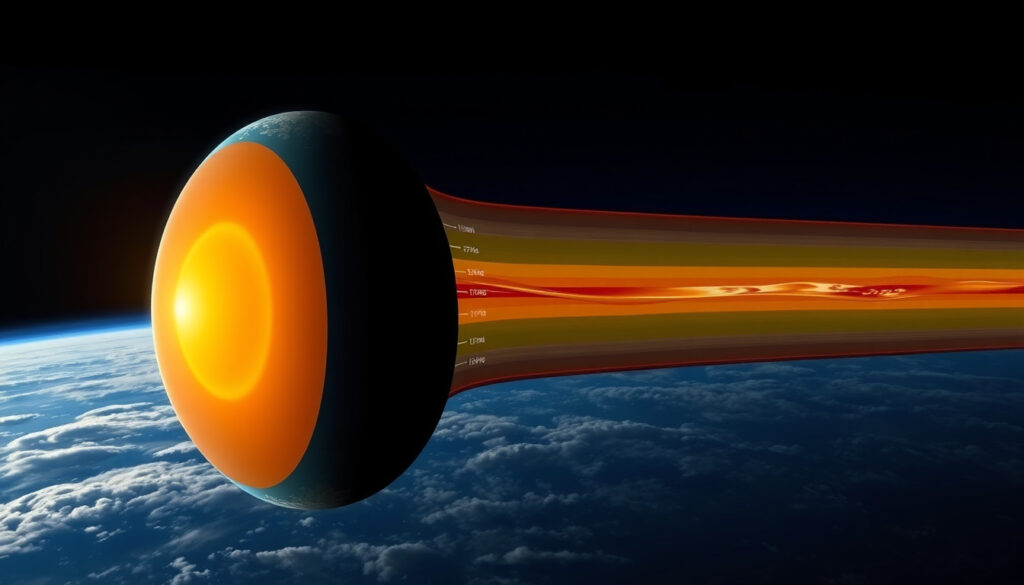
Layers of the Atmosphere: Complete Guide with Altitudes & Facts
You’re reading this from the bottom of a giant, layered cake of air. The atmosphere above you has five distinct layers, each with its own temperature, composition, and job to do — from the weather-filled troposphere to the near-vacuum of the exosphere.
Main layers: 5 (troposphere, stratosphere, mesosphere, thermosphere, exosphere) ·
Coldest layer: Mesosphere (approx –90°C) ·
Thickest layer: Exosphere (600–10,000 km) ·
Layer containing 99% of air: Troposphere (up to 12 km) ·
Layer where planes fly: Stratosphere (10–50 km)
Quick snapshot
- Troposphere extends to about 12 km (NASA Science)
- Mesosphere is the coldest layer at –90°C (UCAR Center for Science Education)
- 99% of water vapor is in the troposphere (NASA Science)
- Exact boundary of exosphere varies (NASA Science)
- Number of layers (5 vs 6 vs 7) depends on inclusion of ionosphere (Drishti IAS)
- Altitude progression: surface → troposphere (0–12 km) → stratosphere (12–50 km) → mesosphere (50–80 km) → thermosphere (80–600 km) → exosphere (600–10,000 km) (NASA Science)
- Climate change alters layer temperatures, especially in the stratosphere and troposphere (UCAR Center for Science Education)
- Future research focuses on the ionosphere’s role in satellite communication (Drishti IAS)
Six key measurements define the atmosphere’s structure — from the thinnest to the thickest, and from the coldest to the hottest. Below is a fact table that gives you a quick reference across all main layers.
| Attribute | Value |
|---|---|
| Number of main layers | 5 |
| Thickest layer | Exosphere (up to 10,000 km) |
| Coldest layer | Mesosphere (–90°C) |
| Hottest layer | Thermosphere (up to 2,000°C) |
| Layer with weather | Troposphere |
| Layer with ozone | Stratosphere |
What are the 7 atmosphere layers in order?
Most references list five main layers, but you’ll sometimes see six or seven when the ionosphere and exosphere are counted separately. The core five — troposphere, stratosphere, mesosphere, thermosphere, exosphere — are defined by their temperature gradients.
List of layers with altitudes
- Troposphere: 0–12 km — weather, 75% of atmosphere’s mass (Sustainability Unlocked)
- Stratosphere: 12–50 km — ozone layer, jets fly here (NASA Science)
- Mesosphere: 50–80 km — coldest layer, meteors burn up (UCAR Center for Science Education)
- Thermosphere: 80–600 km — auroras, high temperatures (NASA Science)
- Exosphere: 600–10,000 km — merges with space, satellites (NASA Science)
The implication: five layers is the standard scientific classification, but adding the ionosphere (a region within the thermosphere) gives six, and splitting the exosphere gives seven. The number depends on whether you count by temperature or by electromagnetic properties.
Why are there 5 main layers versus 7?
The official classification from NASA Science uses five layers based on temperature inversion. The ionosphere is a subregion of the thermosphere where particles are ionized by solar radiation — it’s electrically active but not thermally distinct.
The trade-off: for most educational contexts, five layers is clearer. Six or seven is used when discussing radio wave propagation and space weather.
How do scientists classify layers?
Scientists use the temperature gradient — how temperature changes with altitude — to draw boundaries. The tropopause, stratopause, and mesopause are the boundaries between layers. These are defined by the point where temperature stops decreasing and starts increasing (or vice versa).
The boundary between the stratosphere and mesosphere is where the ozone layer ends — beyond it, UV radiation is not absorbed, and temperatures plunge.
What is the coldest layer of atmosphere?
The mesosphere holds the record for the lowest natural temperatures on Earth. Let’s examine why this middle layer freezes.
Temperature profile of mesosphere
- Temperature drops from about 0°C at 50 km to roughly –90°C at 80 km (UCAR Center for Science Education)
- The mesopause (top of the mesosphere) is the coldest part of the entire atmosphere (NASA Science)
Why mesosphere is coldest
Unlike the stratosphere below and thermosphere above, the mesosphere lacks ozone to absorb UV light and is too thin to trap heat. The limited carbon dioxide molecules there radiate energy into space, cooling the layer further.
“The mesosphere is the layer where most meteors burn up upon entry — the extreme cold and low pressure vaporize them before they can reach the surface.”
— UCAR Center for Science Education
The pattern: the mesosphere is Earth’s cold shield — cold enough to destroy incoming meteoroids, and cold enough to create noctilucent (night-shining) clouds at its top.
What makes 99% of the air?
The air we breathe is a precise cocktail of gases, but nearly all of it is concentrated in just two layers.
Composition of the atmosphere
- Nitrogen: 78%
- Oxygen: 21%
- Argon: 0.9%
- Trace gases: carbon dioxide, neon, helium, methane (Drishti IAS)
Nitrogen and oxygen dominate
Over 99% of the atmosphere’s mass sits in the troposphere and stratosphere combined. The troposphere alone holds about 75% of the total mass because of the weight of the layers above compressing it (Sustainability Unlocked). More than 99% of water vapor — the driver of weather — is also in the troposphere (NASA Science).
Though the exosphere extends thousands of kilometers, it contains less than 0.001% of all atmospheric gases — meaning “space” begins just a few hundred kilometers up, but breathable air is confined to the bottom 12 km.
The consequence: for life on Earth, the troposphere is the only layer that directly supports breathing, weather, and liquid water.
What layer is most important?
Each layer has a purpose, but two stand out for human survival.
Troposphere: where weather and life occur
- Contains 99% of water vapor and all weather systems (NASA Science)
- Supports all terrestrial life through breathable air and precipitation
- Temperature decreases with altitude, creating convection currents
Stratosphere: ozone layer
- Ozone layer absorbs 97–99% of harmful UV-B and UV-C radiation (NASA Science)
- Temperature increases with height due to ozone absorption of UV light (Drishti IAS)
“Without the ozone layer, life on the surface would be exposed to lethal levels of ultraviolet radiation.”
The implication: “most important” depends on context. For daily life, the troposphere is irreplaceable. For long-term health, the stratospheric ozone layer is equally critical. The catch: human activity has thinned the ozone layer over Antarctica, though the Montreal Protocol has helped it recover.
What sphere do planes fly in?
If you’ve ever looked out an airplane window at cruising altitude, you were in the lower stratosphere.
Why planes fly in the stratosphere
- Commercial jets cruise at 10–13 km, placing them in the lower stratosphere (NASA Science)
- The stratosphere is nearly cloud-free and has very little turbulence (UCAR Center for Science Education)
- Less air resistance at that altitude improves fuel efficiency
Advantages of cruising altitude
Flying above the troposphere’s weather systems means passengers experience a smoother ride. Additionally, the thinner air reduces drag, allowing aircraft to achieve higher speeds with less fuel. The trade-off: cabin pressure must be artificially maintained, and oxygen levels are lower.
The pattern: the stratosphere is the “smooth highway” of the sky.
Layer-by-layer specification table
Five layers, one pattern: each has a distinct temperature direction. The spec table below covers altitude, temperature, and key characteristic.
| Layer | Altitude range | Temperature range | Key feature |
|---|---|---|---|
| Troposphere | 0–12 km | 15°C to –56°C | Weather, 75% of mass (NASA) |
| Stratosphere | 12–50 km | –56°C to –2°C | Ozone layer, jets (NASA) |
| Mesosphere | 50–80 km | –2°C to –90°C | Coldest layer, meteors burn (UCAR) |
| Thermosphere | 80–600 km | –90°C to 2,000°C | Auroras, space station (NASA) |
| Exosphere | 600–10,000 km | 2,000°C to near space | Satellites, hydrogen escape (NASA) |
| Ionosphere | 60–1,000 km (overlaps) | Varies | Radio reflection, Northern Lights (Drishti IAS) |
The takeaway: the ionosphere is not a distinct thermal layer but an electrically charged region that enables long-distance radio communication and — when disturbed by solar storms — can disrupt GPS.
Related reading: Is Black a Color – Science, Art and Perception Explained · Tallest Building in the World – Burj Khalifa Still Leads 2024
Frequently asked questions
What are the 5 main layers of the atmosphere?
Troposphere, stratosphere, mesosphere, thermosphere, and exosphere. Some classifications also list the ionosphere as a sixth layer due to its electrical properties.
What is the ionosphere?
The ionosphere is a region extending from about 60 to 1,000 km, overlapping the mesosphere and thermosphere, where solar radiation ionizes molecules. It reflects AM radio waves and produces auroras.
What is the ozone layer and where is it?
The ozone layer sits in the stratosphere at 15–35 km altitude. It absorbs 97–99% of harmful UV radiation from the Sun, protecting life on Earth.
Which layer is the hottest?
The thermosphere can reach up to 2,000°C, though the gas density is so low that a human would freeze — temperature in this context measures particle kinetic energy, not heat transfer.
What is the difference between troposphere and stratosphere?
The troposphere (0–12 km) is where weather and most atmospheric mass exist; temperature decreases with altitude. The stratosphere (12–50 km) is dry, stable, and temperature increases with altitude due to ozone absorption.
How does the atmosphere protect Earth?
The atmosphere blocks harmful solar radiation (ozone layer), burns up meteors (mesosphere), regulates temperature (greenhouse gases), and provides pressure to sustain liquid water. Without it, Earth would be a barren, frozen rock.
What is the exosphere?
The exosphere is the outermost layer, starting at about 600 km and fading into space by 10,000 km. It contains the thinnest air, mostly hydrogen and helium, and is where satellites orbit and molecules can escape Earth’s gravity.
A safe flight, a steady internet connection, and the air you’re breathing right now all depend on the same invisible stack of layers. For anyone studying Earth science or simply curious about the world above, the key takeaway is clear: the atmosphere isn’t one thing — it’s five different worlds stacked on top of each other, each with its own rules and its own critical job.
More related posts
 How Many Days Are in a Year? Leap Year, Months & Origins
 76ers vs Houston Rockets: Match Player Stats 2025-26
 Feliz Día del Padre: Wishes, Dates, and Traditions Guide
 When Is the First Day of Spring? 2026 Dates & Traditions
 UC Berkeley Acceptance Rate 2025: 11.4% Stats & Tips
 Cast of We Were Liars: Full Character Guide & Cancellation
 iPhone 16 Plus Colors: All 5 Finishes Reviewed
 Can You Connect AirPods to a PS5? How to Do It (2025 Guide)